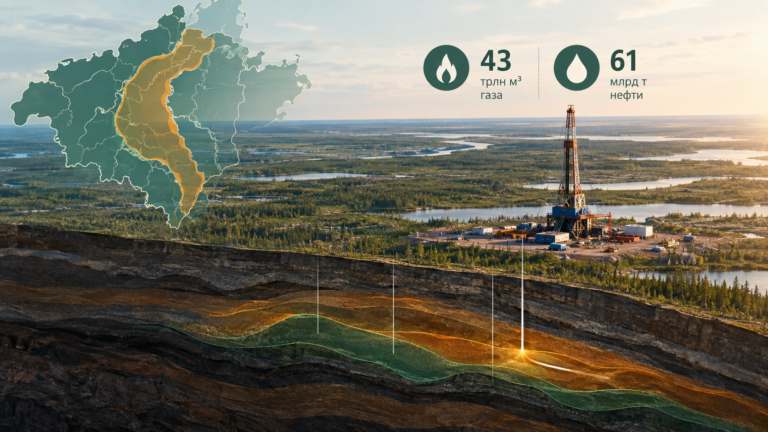
Scientists at the Trofimuk Institute of Petroleum Geology and Geophysics, Siberian Branch of the Russian Academy of Sciences, have calculated that the “Brekhuntsov Belt” may hold at least 43 trillion cubic meters of gas and at least 61 billion tonnes of oil. The estimate was made with 90% probability and refers to geological resources, not confirmed reserves.
The study covered the Jurassic and Cretaceous complexes of the continental part of the West Siberian province. More than 62 trillion cubic meters of gas and about 100 billion tonnes of oil in initial total geological reserves have already been explored here. The “Brekhuntsov Belt” is the contour of proven petroleum potential, first mapped in 2011. Over a decade and a half it has barely changed, expanding only slightly to the north thanks to fields on the Kara Sea shelf and in the Yenisei-Khatanga trough.
According to the scientists, undiscovered hydrocarbons are concentrated mainly in small and very small fields. Large deposits are gradually being depleted, while West Siberia still provides about 59% of Russian oil and 86–87% of its gas. Finding new targets here is therefore critical.
More than 19,000 exploration and appraisal wells have been drilled in the province, but many promising reservoirs remain poorly studied. The Siberian geologists’ estimate is consistent with the view of most researchers: identified oil and gas reserves in West Siberia amount to roughly half of what the basin contains.
At the same time, the industry is mastering technologies for recovering residual reserves at mature assets. In summer 2026, Slavneft-Megionneftegaz, operating at the very center of the “Brekhuntsov Belt,” returned to service the historic well R-1 at the Megionskoye field, which had been mothballed for more than 40 years. Using digital modeling and sidetracked horizontal laterals, it achieved a flow rate of about 20 tonnes per day with water cut of only 20%. For a mature field, where the water share typically exceeds 90%, this is an exceptional result. The project’s experience may be useful for other long-developed areas of West Siberia.
According to TsDU TEK, at the end of the second quarter of 2026, 35,900 oil wells in Russia were mothballed.
The estimate of undiscovered resources shows that West Siberia’s potential has been only half realized. Small deposits and residual reserves of mature fields could become a new source of production if the industry continues to develop enhanced recovery technologies and detailed exploration.
Source: TsDU TEK