The Soviet diamond industry had its presence in Yakutia for decades. There was a cross on the geological map of the European North: kimberlites cannot exist here. But it was in the Arkhangelsk region that geologists risked drilling “blindly” – and found diamonds.
Why look for diamonds in the Arkhangelsk region
In the 1970s, the country was faced with the task of expanding its mineral resource base. Diamonds were needed not only for jewelry, but also for industry – cutters, drills, machine tools. Relying on one region became risky, and the USSR Ministry of Geology gave the order to look for new territories.
The Arkhangelsk region is included in the list of promising ones: the Baltic Shield passes through here, an ancient section of the earth’s crust where kimberlite pipes could be hidden. Back in the 1930s, traces of volcanism were recorded, and in the 1960s, pyropes and ilmenites, satellite minerals of diamonds, were found on the White Sea coast. There was enough evidence not to write off the north. Therefore, the bet was placed not on a quick result, but on testing a hypothesis that could change the map of the country’s diamond-bearing provinces. So geologists had a bold but risky task: to check the north for diamonds. And here began the most difficult part – the search for what is not visible.
Yakutia, Arkhangelsk region – where else are diamond deposits hidden? Read in the article “Diamond mining areas: where in Russia they are looking for new deposits”
When you’re looking for something you can’t see
The main difficulty of searching in the Arkhangelsk region is the complete lack of landmarks. Kimberlite pipes here are hidden under tens of meters of Quaternary sediments. The thickness of sand and clay in some places reached 60–80 meters, and it was possible to reach the crystalline foundation only with the help of a drilling rig. This is not a “shovel into the ground”: drilling required heavy equipment, fuel, and an installation site.
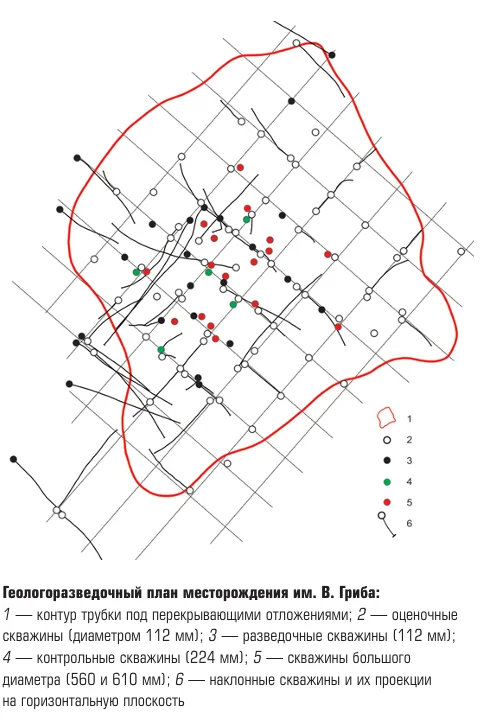
On the surface there is not a single fragment of kimberlite that would suggest the right place. Everything had to be checked “blindly” – well after well, hundreds of meters of metal were dug into the ground for the sake of tiny chances of stumbling upon a pipe.
Technology didn’t make the task any easier either. Each new point required arrangement from scratch: installing a drilling rig, supplying fuel, and providing housing for the party. They worked based on indirect evidence: rare finds of pyropes and ilmenites, which could easily turn out to be brought by the glacier tens of kilometers away.
Funding was no easier. The ministry doubted: would there be any prospects? Money continued to flow to Yakutia, and the north of the Arkhangelsk region was considered a risky experiment. Geologists had to fight for every new meter of drilling – both in reports and in the offices of their superiors.
Russian pioneers distinguished themselves not only in their homeland, but also in other countries of the world. Read more in our material “The history of diamond mining in Canada”
From a chance find to the Lomonosov deposit
A turning point in search came unexpectedly. In the mid-1970s, Elisey Verichev’s team from the Kuloi geological survey party (senior geologist Anatoly Stankovsky) noticed an unusual stone in the bed of the Mela River. They picked him up, but in a hurry they dropped him back into the water, then they found him again and decided to clear the shore. The bedrock samples contained diamond crystals. For the first time, a direct trace of kimberlites was recorded on the territory of the Arkhangelsk region.
This data was received by the heads of Arkhangelskgeology, Mikhail Tolkachev and Vladimir Grib. They secured funds for aeromagnetic surveys, and planes and helicopters with instruments flew over the northern regions of the region. The result exceeded expectations: hundreds of magnetic anomalies were discovered.
The first to be drilled was the Tuchkin anomaly. At a depth of only 30 meters, the drill reached the Pomorskaya kimberlite pipe. In the core – cylinders of rock that are lifted from wells to the surface – 39 diamond crystals were counted. This was not a random signal, but a real confirmation of the region’s prospects.
Soon new discoveries were added to the Pomeranian. Six pipes formed into the Lomonosovskoye deposit – the future basis of the Arkhangelsk diamond-bearing province. Doubts were replaced by confidence: the north turned out to be not a “blank spot”, but the country’s new diamond territory.

From the first crystals to industrial production
By the mid-1980s, it became clear: the reserves of the Lomonosov field are truly impressive – they are enough to change the balance of the entire industry. But the path to industrial production was not easy: the project took almost twenty years to launch.
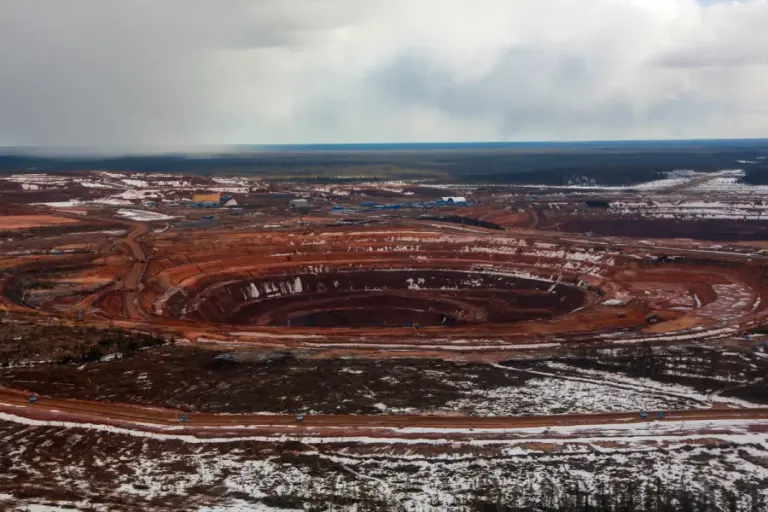
In 2005 The Severalmaz mining and processing plant was put into operation, and the first diamonds from the Lomonosov deposit entered the world market. Today it is the largest diamond mining center outside of Yakutia.
- There are enough deposit reserves more than nA 50 years of production – according to the chief geologist of Severalmaz, Ilya Zezin.
- The company maintains production at approx. 2.9 million carats per year (approximately 10% of the total plan for Alrosa).
- Two pipes are included in the development – Arkhangelskaya And Karpinsky‑1, with open-pit mines and factories in 2005 and 2013.
- Total production from the Lomonosovskoye field after the launch of factories grew up With about 0.5 million to 2 million carats per year.
Today the Lomonosovskoye field is not just an operating site, but a symbol of the strategic diversified balance of diamond mining. It confirmed that we cannot remain in geological anticipation, and that risky decisions could become the foundation of a new diamond province for the country.
What the history of the Lomonosov deposit has given us
The history of the Lomonosov deposit reminds us that in geology there are no “hopeless” territories. You just have to check again and the map of mineral resources may change.
The Lomonosov discovery showed that major discoveries are made not only in “obvious” regions like Yakutia, but also in places where they have given up for a long time. It gave the Arkhangelsk region a new role on the geological map and proved that persistence and willingness to test a hypothesis can change an entire industry.
This is especially true today. Demand for diamonds and other minerals is growing, and easy discoveries are long behind us. And this means that the experience of the Lomonosov field is inspiring: even where it seems empty, a new resource center may be hidden.
Have you worked in “unpromising” regions, where you didn’t expect results, but in the end you found something significant? Tell us in the comments
Photo: Grannushka blog, LiveJournal – source