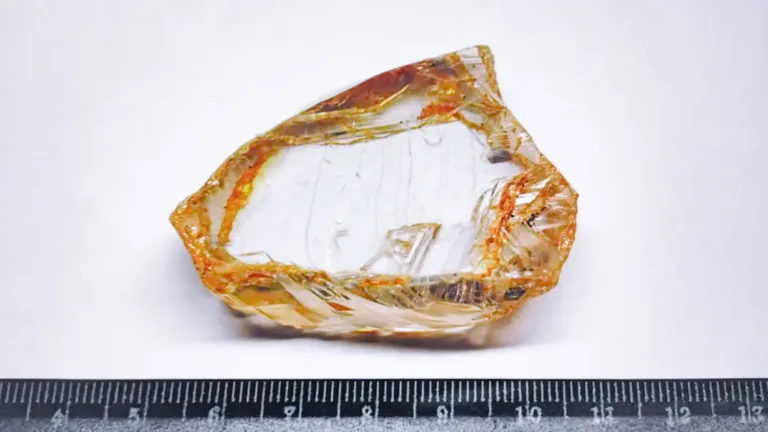
Ask a geologist, jeweler and drilling engineer what types of diamonds there are and you will get three different answers. And all three will be correct. A geologist will start with genesis, a jeweler – with color and purity, a driller – with whether the stone is suitable for decoration or will go into a drill bit.
Behind one word diamond there are at least four classifications, and even specialists in related fields get confused in them. Let’s figure out how everything works together with the chief geologist of the Arkhangelsk Geological Exploration Company, Vladimir Shchukin, using practical examples from the industry.
Diamond ≠ diamond, but a type of mineral
Before looking at the classifications, let’s remove the main confusion: diamond and diamond are not synonyms.
Diamond is mineral, cubic crystalline modification of carbon and the hardest of natural materials: 10 points on the Mohs scale. A diamond is a gem-quality diamond that has already been cut and is ready to be set into a ring. When they say “types of diamonds,” we are talking about the cut (round, “princess,” “marquise”), and “types of diamonds” are about the stone itself: its origin, composition of impurities, size in carats, crystal shape and suitability for work.
Next we are talking specifically about diamonds that a geologist picks up from a tube and an engineer sorts at a factory. Most of them will not make it to the jewelry counter.
Types of natural diamonds by genesis
Where a gemstone comes from is the most fundamental classification. There are four categories, and they are fundamentally different.
- Indigenous springs – kimberlite and lamproite tubes. The diamond formed and the tube carried it to the top.
- Placer diamonds – the same kimberlite ones that have received a second life. They were washed out of the destroyed pipes and carried away by rivers or glaciers.
- Impact diamonds – minerals not from the mantle. The carbon in the host rock turns into crystal within a fraction of a second when a large meteorite hits. Such gems have been discovered in Popigai crater.
- Metamorphogenic diamondsformed at high pressures in collision zones of lithospheric plates, without volcanism find in the Kokchetav region of Kazakhstan.
This classification of diamond mining types does not say anything about the color, clarity or price of the mineral. The same stone can be kimberlite in genesis and yellow type Ia in physics.
Read also: Diamond mining areas: where in Russia they are looking for new deposits— how geologists find kimberlite pipes, why out of 800 in Russia only 13 turned out to be industrially significant
Physical Types and Colors of Diamonds
According to the second classification, the crystal itself is assessed – whether there are any impurities in it. The system was proposed physicists Kaiser and Bond in 1959, the Soviet school modified it. The separation is based on one parameter – the presence of nitrogen impurities.
- Type Ia — there are two or four nitrogen atoms in the crystal lattice. This includes up to 95% all natural diamonds. All this is an ordinary diamond – the one found in most jewelry stores. Such a stone is not yet produced in the laboratory.
- Type Ib — nitrogen is scattered by single atoms. This stone is rare in nature, but is a typical variety of synthetic HPHT diamonds.
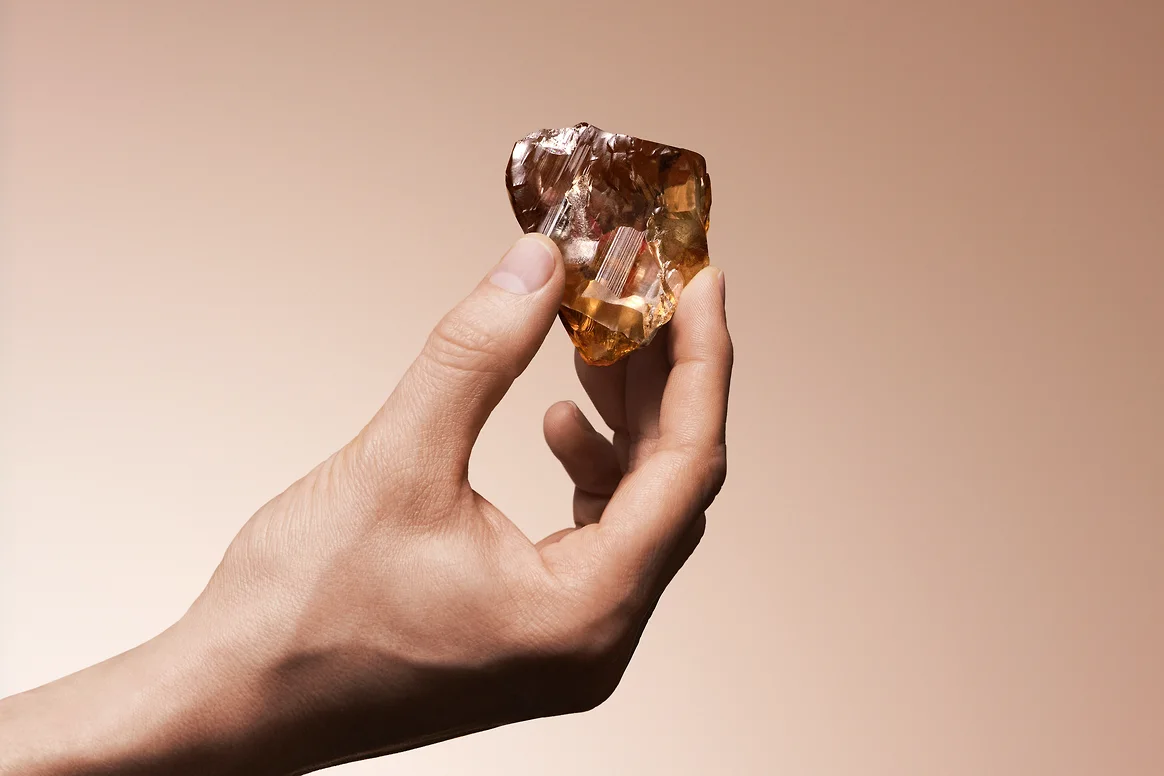
- Type IIa – almost pure carbon. Among natural diamonds there are only 1–2%, for example, large stones “Cullinan”, “Lesedi La Rona”. Most CVD synthetics are also type IIa.
- Type IIb — contains an admixture of boron. The only one of all types that conducts electric current. The stone is presented in blue and dark blue tones, but is rarely found in nature.
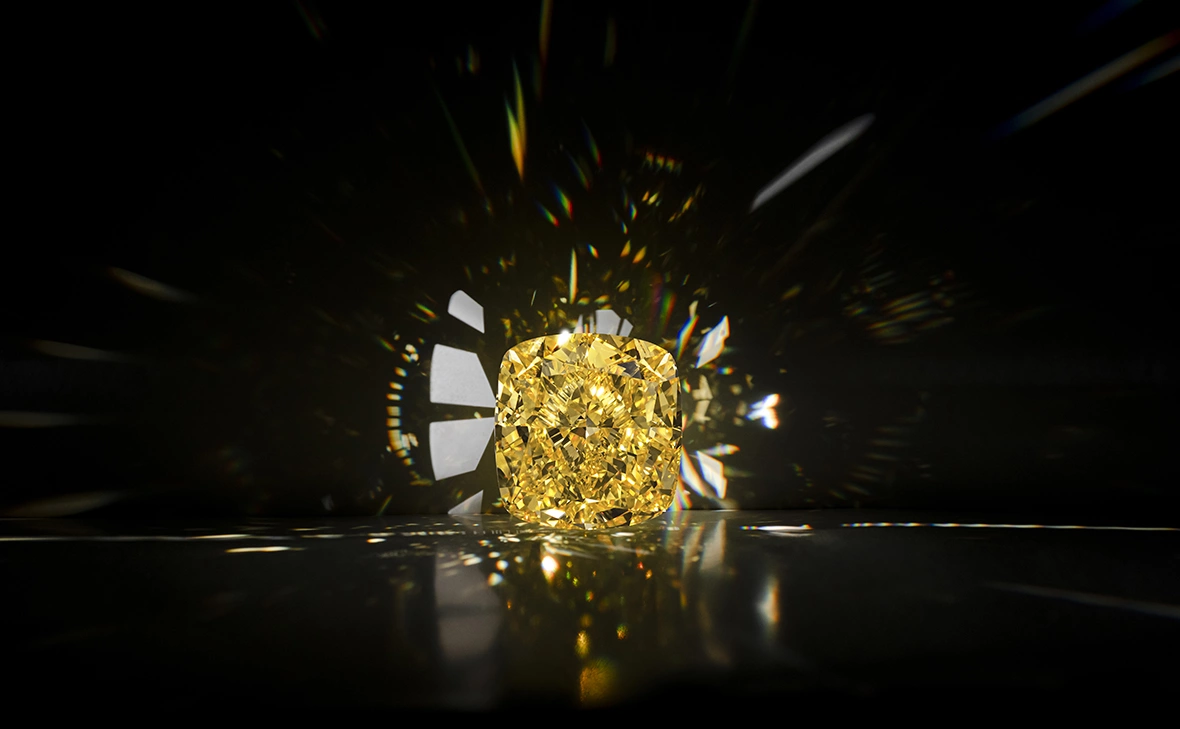
The types of diamond colors are directly related to the type. Yellow and brown – from nitrogen (types Ia, Ib). Blue and blue – from boron (type IIb), such as the famous Hope Diamond at 45.52 carats. Pink and red – plastic deformations of the lattice that arose after the formation of the stone. Greens – the only color that a diamond receives from radiation from neighboring radioactive minerals. This coloring is often present only in the surface layer – as soon as you cut it with a cut, the color goes away.
Why is this classification of diamond types needed in practice? The gemologist immediately classifies the colorless mineral of type Ia as natural. Colorless type IIa is sent to the laboratory: with a high probability it is CVD synthetics or a natural stone that has undergone HPHT treatment. By type, experts determine where the diamond can be used. Thus, microelectronics requires crystals without nitrogen defects, and this is the rarest type IIa.
“Man-made diamonds will not go into electronics. Electronics is an important problem that can be solved with diamonds: a microchip platform, a completely different conductor. But for this you need diamonds without nitrogen compounds, only pure carbon. When nitrogen is included in the center of the crystal, their properties change. And such nitrogen-free natural diamonds are very highly valued,” Vladimir Shchukin.
Industrial classification: GOST and types of diamonds by purpose
The third classification is commodity. The industry needs to understand what to do next with the stone. In Russia this is regulated GOST R 59303-2021. Any crystal according to it describe four characteristics: size-weight group (through sieve screening and carat weight), crystal shape, color and quality (defectivity).
The industry division by application is based on these characteristics:
- Jewelry – the most valuable. Transparent, without visible inclusions or cracks, suitable for cutting into diamonds.
- Jewelry — borderline class: formally suitable for cutting, but defects, color or shape reduce the quality of the finished diamond. Some of them are still cut, some go to the technical sector.
- Technical – something that will not go into decoration. This is not a chemically different diamond, but the same mineral with a different morphology: bead (fine-grained aggregates of randomly oriented crystals), ballas (round radial aggregates), carbonado.
In world production, industrial grades account for about 40%. In the overall consumption of industrial diamonds, natural stones are almost completely replaced by synthetics – drill bits, abrasives, and cutting tools are now made from laboratory raw materials.
Types of artificial diamonds: HPHT and CVD
The fourth classification is by origin. By USGS data, in the USA alone, about 97% of industrial diamonds are coated with synthetics. There are two growing technologies.
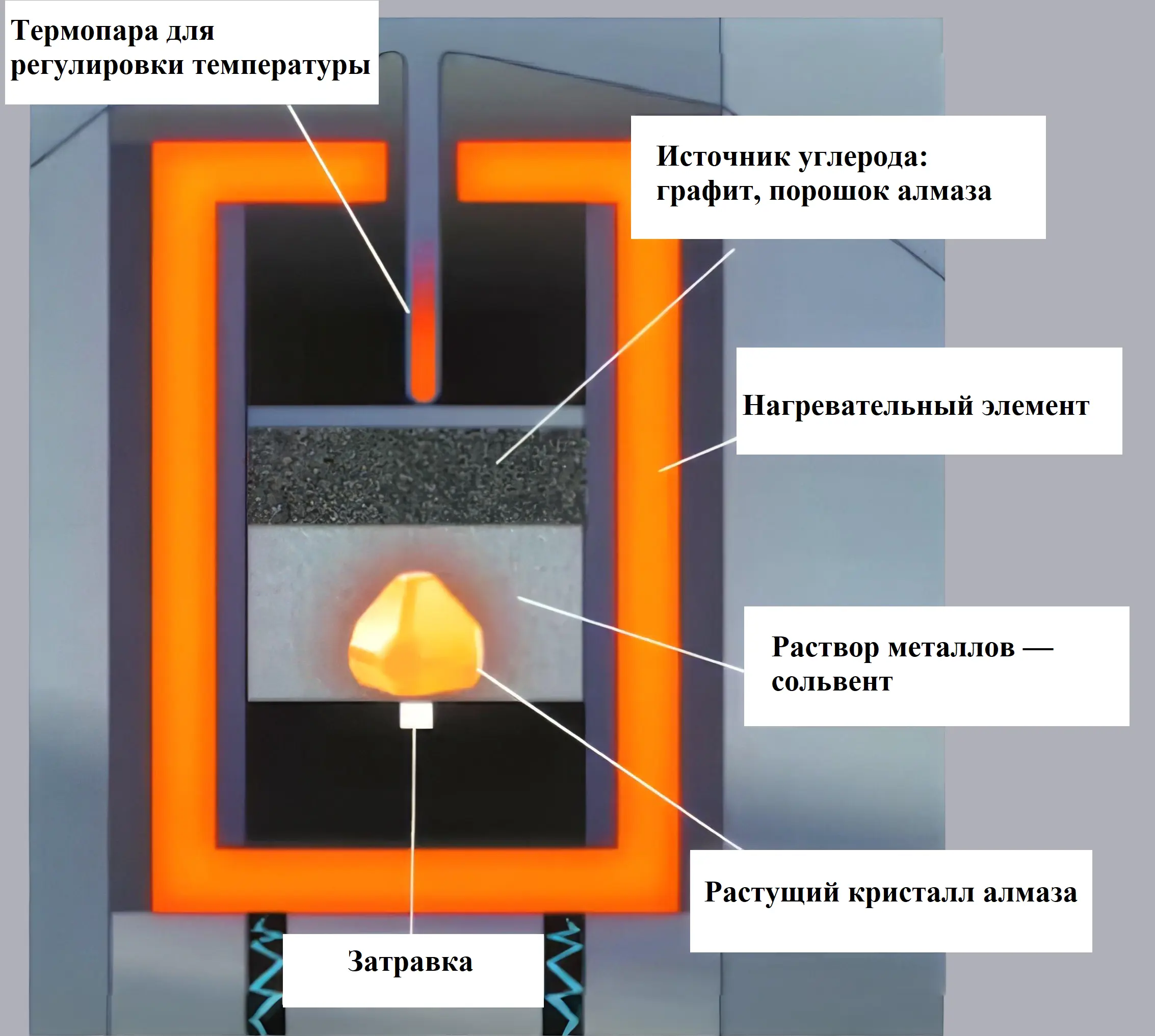
HPHT (High Pressure, High Temperature) is an old method that recreates conditions like in the mantle. Graphite and metal catalyst compress up to 5–6 GPa at 1300–1600 °C – The process can take weeks or months. The resulting crystals most often belong to physical type Ib (with single nitrogen atoms) and take on the cuboctahedral shape characteristic of HPHT synthetics.
CVD (Chemical Vapor Deposition) is a modern method. In a vacuum chamber on a seed diamond plate is besieged carbon from a mixture of methane and hydrogen decomposed by microwave plasma. The stones grow layer by layer. CVD diamonds are usually include to type IIa – almost pure carbon.
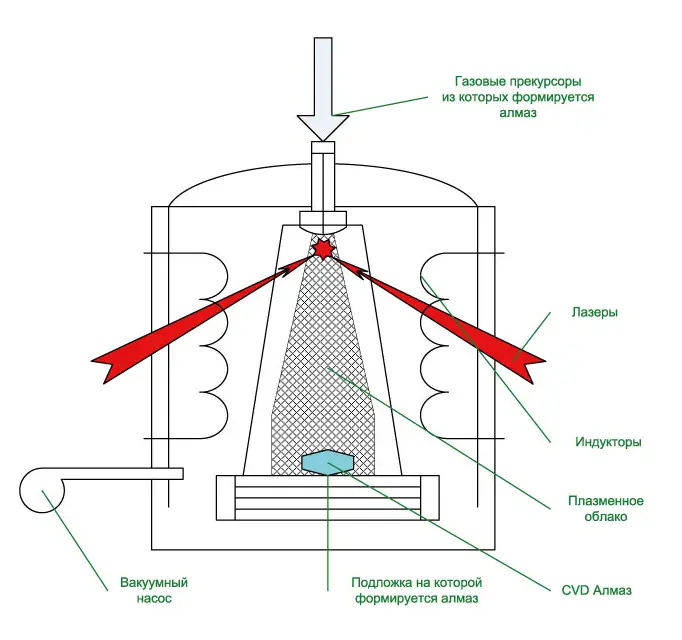
For example, St. Petersburg New Diamond Technology grows HPHT diamonds weighing more than 100 carats and makes them into wafers for electronics and quantum technologies. Here, synthetics do the job that natural diamond cannot do.
Read also: New technologies in the production of synthetic diamonds for electronics — about NDT and wafers for semiconductors. And if you are wondering who will win the confrontation between natural and synthetic stones, we have separate analysis “Natural diamonds versus synthetics”.
What four classifications say about stone
The same diamond is described from several sides at once: history (where it comes from), physics and color (what’s inside), product category (what it’s good for), origin (nature or laboratory). To fully characterize a stone, you need all four characteristics at once.
For example, in November 2025 in the Arkhangelsk region at the Grib field found two stones weighing 55.96 and 135.75 carats – transparent, without inclusions, typical of the northern diamond profile. By genesis – kimberlite. According to physics, it is almost certainly type Ia. According to GOST – jewelry. By origin – natural. This is exactly what each classification says about the stone.
Which classification is more familiar to you? Tell us in the comments.
The cover photo was taken from the official website of AK ALROSA (PJSC)