Natural gas is a complex mixture of methane, ethane, propane, and butane. It is used to make the basis for plastics, medicines, fertilizers and microelectronics. Together with experts from the chemical industry, we are looking into how natural gas is changing and where gas processing is heading today.
What is gas processing
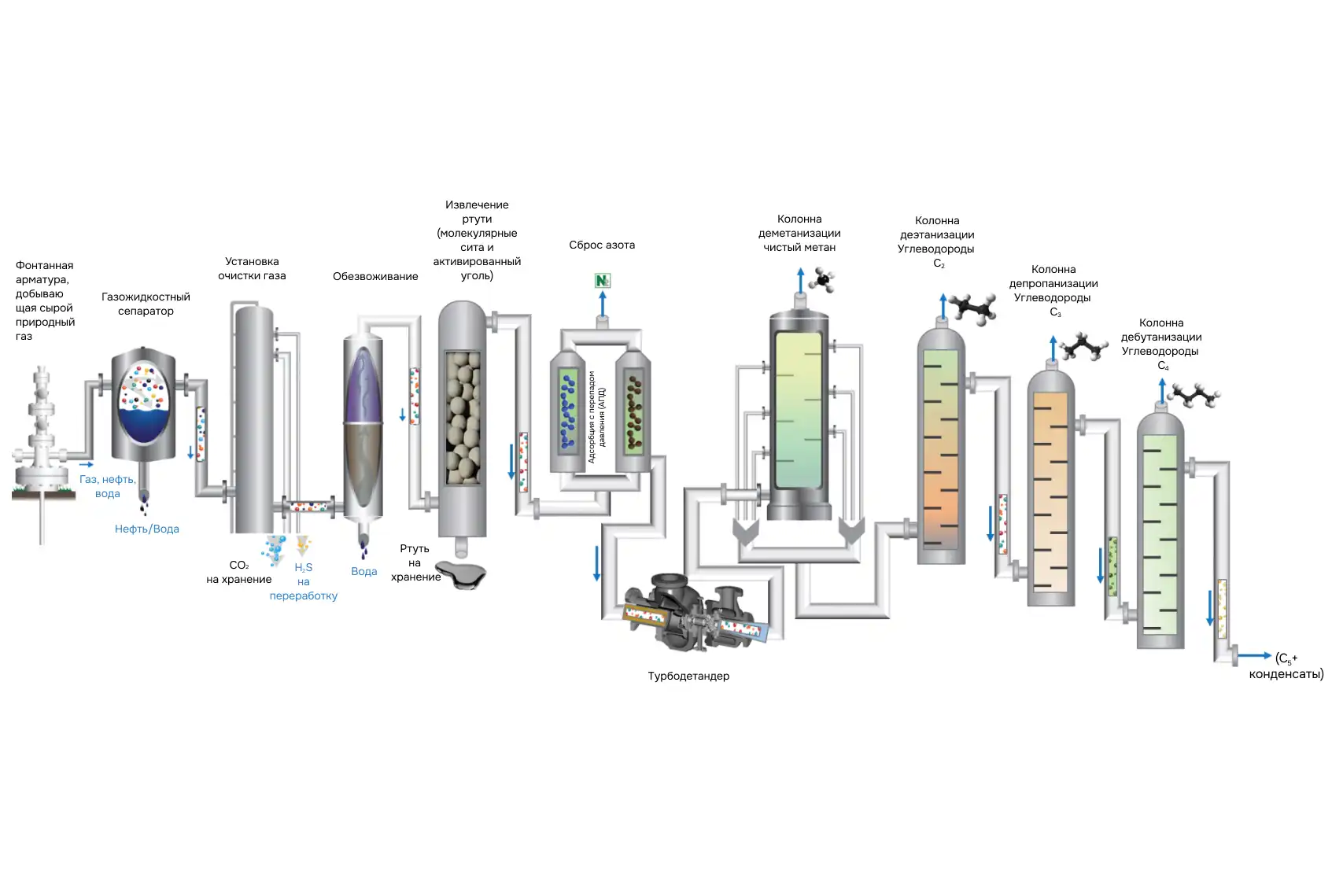
To use gas in industry and energy, it is purified, dried and separated into components. This are engaged gas processing plants (GPPs) – enterprises, where the raw material flow passes through preparation and separation systems.
At the first stage, water, hydrogen sulfide, carbon dioxide and mechanical impurities that interfere with transportation and create ice jams in systems are removed from the gas.
The flow then enters the columns where is happening separation of hydrocarbon components. Methane, the basis of natural gas, and heavier fractions: ethane, propane, butane and pentane are released here. These substances are called gas condensate components, and it is from them that many basic gas processing products are obtained.
Next, deep processing of natural gas begins. From purified methane and other fractions get chemical products of gas processing – methanol, ammonia, formaldehyde, hydrogen and helium.
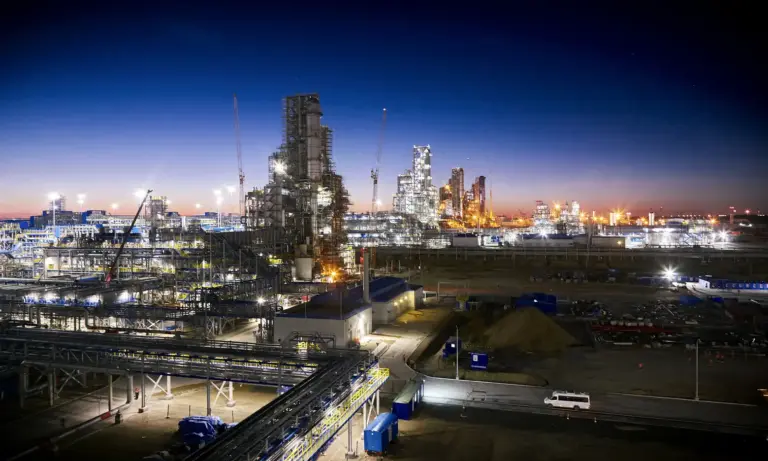
There are more than 30 gas processing plants in Russia. Each of them has its own production volume. For example, at the Amur Gas Processing Plant, annual primary processing pass 42 billion m³ of natural gas.
How students master offshore gas production – read our material
Main gas processing products and their applications
After stages of purification and separation, natural gas is transformed into a collection of valuable components, each of which becomes the basis for entire industries.
Methane – the lightest component that is used as fuel and raw materials for the production of hydrogen and methanol. It is based on energy, petrochemicals and synthetic fuel production.
Ethane, propane and butane — key hydrocarbons for the petrochemical industry. They are used to produce plastics, polyethylene and polypropylene, synthetic fibers and solvents. A mixture of propane and butane forms liquefied petroleum gases (LPG) – fuel for household cylinders, autogas and raw materials for the production of olefins.
Wide fraction of light hydrocarbons (NGL) serves as an intermediate raw material. Components are isolated from it for the further production of plastics and high-molecular polymers.
One of the important processed products is gas condensate – a mixture of heavier hydrocarbons (C5+). It is used to produce gasoline and kerosene fractions, diesel fuel and naphtha components, which are then used in petrochemicals.
Methanol and ammonia, obtained from natural gas, are in demand in the chemical industry and agriculture: they are the basis for fertilizers, organic synthesis and the production of resins.
“Methanol is one of the most versatile gas processing products. It is in demand both as a solvent, as a fuel additive, and as a reagent in the production and transportation of natural gas – this is already forming a large market. But the main thing is that methanol serves as a platform molecule for fine chemistry: dimethyl ether, certain pharmaceutical substances, olefins and many other compounds are obtained from it. Another advantage is its liquid form, which makes methanol easy to transport and include in different production chains.”
explains Candidate of Chemical Sciences Alexander Kustov
When purifying gas, sulfur-containing products are also released. Elemental sulfur and sulfuric acid are used in chemical production, metallurgy and battery production.
Helium, released at modern gas processing plants, is used in medicine, cryogenic technology, microelectronics, optical fiber and high-precision welding. Thus, gas processing provides raw materials for dozens of industries – from energy and petrochemicals to microelectronics and agriculture.
| Component | Wellhead gas, mol% | Pipeline gas, mol% |
| Methane | 70-98 | 95-98 |
| Ethane | 1-10 | 2-5 |
| Propane | Traces – 5 | 0,5-1,5 |
| Bhutanes | Traces – 2 | 0,2 – 0,5 |
| Pentane | Traces – 1 | Traces |
| Hexanes | Traces – 0.5 | Traces |
| Heptanes and heavier | Traces | Traces |
| Carbon dioxide | Traces – 3 | 0,5 – 2,0 |
| Nitrogen | Traces – 15 | 0,5 – 1,5 |
| Hydrogen sulfide | Traces – 2 | <0,000004 |
| Mercury | *From 200 to 300 µg/m3 | *From 200 to 300 µg/m3 |
| Water | Traces – 5 | <0,0001 |
Why is the importance of “non-fuel” gas processing products growing?
More and more companies strive use natural gas components not as an energy carrier, but as raw materials for the chemical and processing industries. Modern technologies – deep fractionation, membrane separation, catalytic processes – make it possible to extract from gas a maximum of useful components that were previously lost during production or flared. This shift in focus has to do with economics.
“Deep processing of natural gas today is one of the key innovative areas of development of the chemical industry. The production of plastics, synthetic resins and rubbers not only increases the output of high-value products, but also creates new jobs, supporting the development of related industries – from the automotive industry to construction and housing and communal services,” comments Salavat Aminev, vice-president of the Russian Union of Chemists.
Russia is also moving in this direction. The country is building and modernizing large gas processing complexes, including the Amur and Ust-Luga gas processing plants, where LPG, ethane, methanol and helium are produced. This not only expands the range of processed products, but also reduces volumes of flaring of associated gases, reducing methane and CO₂ emissions.
As a result, the growing importance of “non-fuel” gas processing products reflects a general trend – a combination of technology, economics and ecology. Advanced processing transforms natural gas from an energy source into the basis of the chemical industry and makes the energy sector more sustainable and cleaner.
About what products are obtained from oil – in our material
Gas of the future: energy, chemistry, ecology
Processing natural gas is not just a way to obtain fuel. From its components are born plastics, fertilizers, helium, hydrogen and methanol – the materials on which modern chemistry and technology rest.
Today, advanced processing transforms gas into a feedstock for a low-carbon economy. In Russia this process is accelerating. Companies like Rosneft invest hundreds of billions of rubles in the processing of associated gas, reducing flaring and emissions. For some, this is the path to green energy, for others – to a new value-added economy. But in any case, gas is increasingly becoming the basis of chemical and technological progress.
Have you ever wondered how many things around us start with a molecule of natural gas?
The cover photo was taken from the official website of the ANO “Agency for Attracting Investments of the Amur Region”