Researchers from the University of Liverpool studied olivine crystals and made an unexpected discovery. This mineral forms the basis of the Earth’s upper mantle. It is its behavior that determines how continents move and plate tectonics works. It turned out that scientists For many years, one of the mechanisms that allowed crystals to change shape under pressure was underestimated.
Olivine, like any mineral, consists of a crystal lattice. When the rock experiences a load, microshears—dislocations—occur in this lattice. Previously, geologists believed that there were two such shift directions. The third direction was considered rare and was not taken into account when describing deformities.
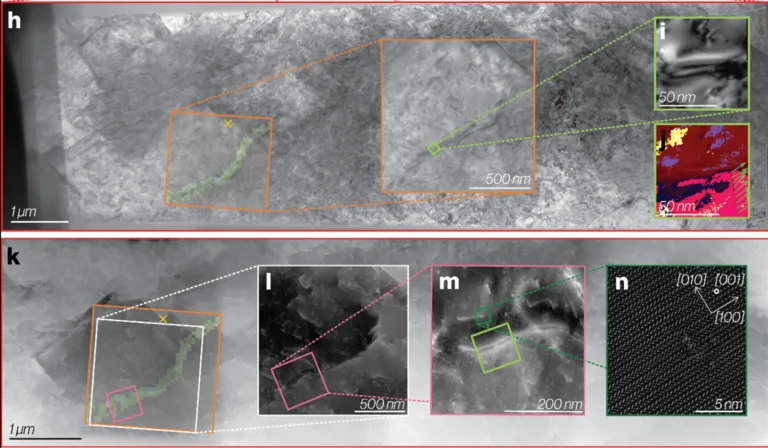
The team, led by Professor John Wheeler, used a modern technique – backscattered electron diffraction. The method allows you to see minute changes in the orientation of the crystals. The researchers scanned the samples and found that in about 17% of cases the deformation was in an unaccounted for direction. To eliminate the error, the scientists took a high-power transmission electron microscope and directly photographed the dislocations. The photographs confirmed the hypothesis.
This changes the understanding of processes in the bowels of the planet. Perhaps the activation of a rare type of shift depends on conditions – pressure, temperature and load level. If this is so, then by the presence of such dislocations in natural samples, geologists will be able to determine at what depth and under what conditions the rock was deformed.
Besides, the study showedthat the diffraction method is excellent for quickly searching for the desired zones in crystals. Instead of blindly studying samples, scientists can now precisely target promising areas and examine them in detail under a microscope.
The practical benefits of the discovery extend beyond geology. Olivine is close in structure to perovskites, materials that are widely used in industry, including electronics. In semiconductors, dislocations often arise as manufacturing defects and impair the performance of devices. The methods developed on olivine will help materials scientists control the quality of crystals and increase the reliability of chips.
Source: Phys.org
Image: Geophysical Research Letters (2025)