Russian geologists, together with colleagues from other countries, drilled through the ice in East Antarctica and got to the bedrock. They wanted to understand the nature of a mysterious magnetic anomaly that stretches along the coast for more than five hundred kilometers. The result exceeded expectations: a fragment of an ancient volcanic arc was discovered under kilometers of ice.
Antarctica remains for science “terra incognita”. An ice sheet more than two kilometers thick reliably hides the continent’s crust. There is almost no direct evidence of what is hidden below. Getting to the stone is difficult, expensive and requires unique equipment.
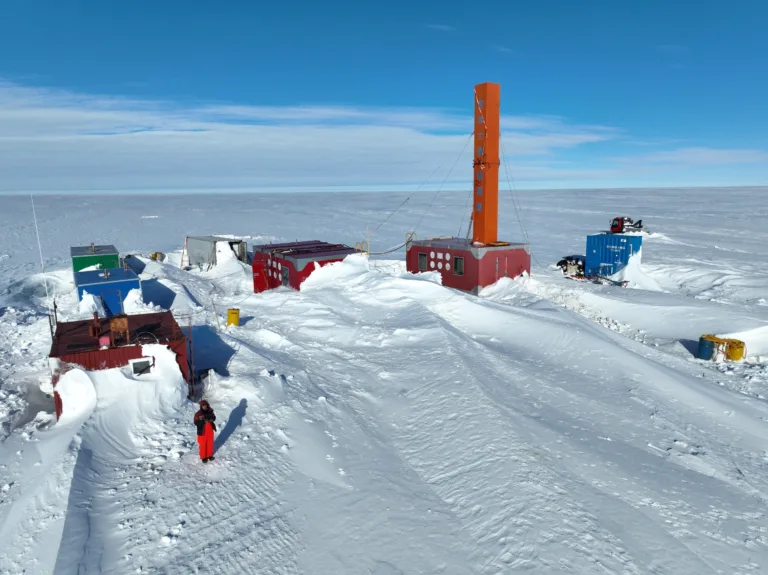
In January 2026, for the first time in history, a Russian-Chinese team drilled a well to a depth of 540 meters and recovered a core – a sample of bedrock. The location was not chosen by chance. Before this, detailed magnetic and radar surveys were carried out here. Scientists were interested in the source of a powerful anomaly, similar to a seam between ancient blocks of the earth’s crust.
Samples were sent to St. Petersburg. In the laboratories of St. Petersburg State University, specialists used the most modern methods: we studied the chemical composition, carried out isotope analysis and uranium-lead dating of zircons. This made it possible not only to determine the type of rock, but also to accurately determine its age.
It turned out that dark crystalline granulite lies under the ice. It is he who creates the very anomaly that instruments on the surface see. But the main thing is the origin of this stone.
Project manager German Leichenkov explained that the granulite turned out to be a fragment of an ancient volcanic island. About a billion years ago, this island collided with the Antarctic continent. The collision became part of a grandiose process – the birth of the supercontinent Rodinia. Then almost all of the Earth’s land came together.
The igneous rock that became the ancestor of granulite formed approximately 970 million years ago. Later, about 890 and 800 million years ago, it was twice subjected to monstrous heat and pressure. The temperature rose to 800 degrees, and the pressure was like at a depth of 15–18 kilometers.
Now scientists know for sure: the magnetic anomaly of East Antarctica is a scar from an ancient collision of continents. The discovery not only sheds light on the history of the formation of supercontinents. It helps study ice sheet dynamics and better understand how Antarctic ice behaves in a changing climate.
Source: Phys.org
Image: SPbU