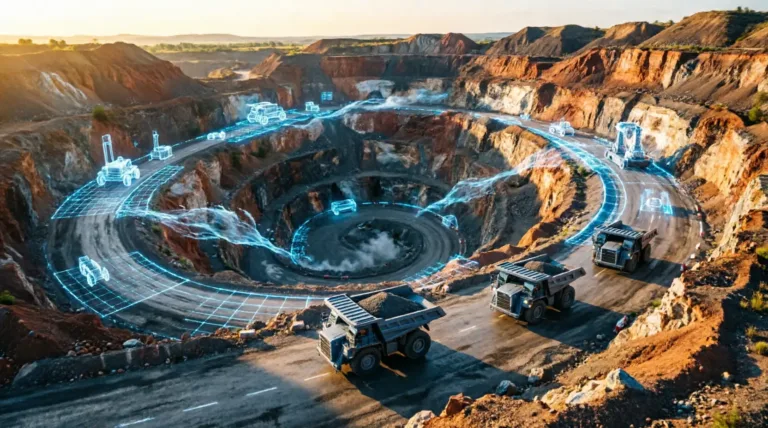
By 2031, the mining industry could look dramatically different from today. Artificial intelligence is already operating driverless haul trucks, predicting equipment failures, and identifying mineral deposits in locations where geologists once spent months conducting manual analysis. According to Grand View Research, the global AI market in mining reached $41.77 billion in 2025 and could expand to $685.61 billion by 2033. Behind these numbers lies a more tangible story — the transformation of how people work in the industry.
Nearly Four Thousand Robots in Open-Pit Mines
As of July 2025, 3,832 autonomous mining haul trucks were operating worldwide. More than half were deployed in China, with the remainder working in Australia, Canada, and Chile. In April 2026, Komatsu commissioned its 1,000th ultra-class autonomous haul truck, while Caterpillar plans to expand its autonomous fleet to 2,000 units by 2030.
In Kazakhstan, ERG became the first company in the country to deploy autonomous haul trucks at the Vostochny coal mine. By early 2026, the vehicles had transported more than 2 million tonnes of material across 17,000 trips using a dedicated private 5G network. ERG aims to increase this figure to 115 million tonnes by 2027. The economic impact of the group’s digital initiatives exceeded $111 million in 2025 alone.
Geologists No Longer Spend Months in Archives
Generative AI systems can convert terabytes of legacy reports, field notebooks, and historical maps into standardized digital datasets within hours. AI then uses this information to build three-dimensional probabilistic deposit models and identify the most promising drilling targets.
Human experts remain central to the process. Instead of eliminating geologists, AI removes routine tasks that previously consumed up to 80% of their working time. This approach, often described as the “geologist-in-the-loop” model, allows specialists to focus on validating hypotheses and making decisions while machines handle data processing and preliminary analysis.
Ten New Professions on the Horizon
By 2031, the mining sector is expected to create a range of new occupations that scarcely exist today. Data geologists will prepare geological information for machine-learning systems. Digital twin engineers will manage virtual replicas of mines capable of simulating accidents and operational scenarios before they occur. Autonomous systems coordinators will oversee fleets of driverless vehicles and drilling rigs remotely from urban control centers.
At the same time, several traditional roles are expected to shrink significantly or disappear altogether. The number of haul truck drivers and surface drilling operators could decline by 70–80% by 2031. Cartographic technicians and drafting specialists are likely to be replaced by generative AI tools, while manual laboratory sampling jobs are increasingly being substituted by real-time conveyor-based analytical systems.
Lower Costs and New Opportunities
Labor expenses currently account for 30–40% of operating costs at conventional mines. By 2031, that share could fall to 18–22%. While highly skilled workers will command higher salaries, overall workforce numbers are expected to decline. As a result, total sustaining costs per tonne of metal produced could decrease by 15–22%. Such reductions would make low-grade deposits economically viable, opening resources that are currently considered uneconomic to develop.
Kazakhstan has declared 2026 the Year of Digitalization and Artificial Intelligence. The country has launched the national AI center Alem.AI and commissioned Central Asia’s largest supercomputing cluster, which has secured a place in the global TOP500 ranking.
The European Union is taking a different approach, emphasizing oversight and regulation. Under the EU AI Act, workforce management systems used at hazardous industrial facilities are classified as high-risk applications. As a result, mining companies are increasingly hiring algorithm auditors and compliance engineers to meet regulatory requirements.
Companies that successfully combine advanced AI technologies with the expertise of human specialists are likely to gain a significant competitive advantage. Their edge will come not only from higher production volumes, but also from faster and deeper analysis of the vast amounts of data generated across modern mining operations.
Source: Arthur Poliakov