Russian researchers have discovered the rare mineral Bradleyite inside diamond, formed in the deep layers of the mantle. This discovery forces the scientific community to reconsider existing models of mineral formation and better understand the chemical processes occurring in the depths of our planet.
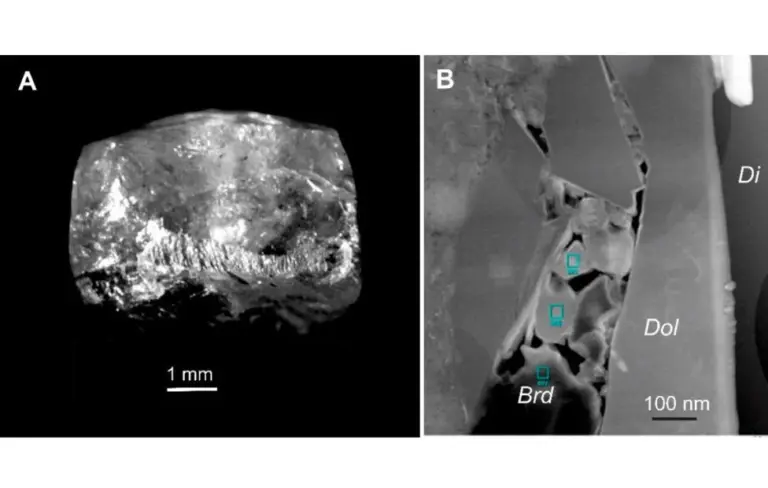
Specialists from the V.I. Vernadsky Institute of Geochemistry and Analytical Chemistry of the Russian Academy of Sciences made an important discovery while studying deep-seated diamonds. In one of them they discovered inclusions of bradleyite, a rare phosphorus-containing carbonate with the formula Na₃Mg(PO₄)(CO₃).
This mineral ended up inside a diamond that was brought to the surface by a kimberlite magma flow. Scientists emphasize that the presence of bradleyite proves the existence of carbonate fluids with phosphorus in the deep layers of the Earth. These fluids actively influence the formation of diamonds and the transformation of rocks.
The particular significance of the discovery is that bradleyite is part of the carbonatite association along with minerals containing chlorine, fluorine and other phosphorus-containing elements. This changes traditional ideas about the chemical composition of the mantle, where it was previously believed that silicates, oxides and ore minerals were formed predominantly.
For a detailed study of the structure of the find, modern analysis methods were used: electron microscopy, x-ray diffraction and three-dimensional modeling. These technologies made it possible to accurately reconstruct the crystal lattice of the mineral and determine its resistance to extreme pressures and temperatures characteristic of the deep layers of the Earth.
The results of the study, published in the journal American Mineralogist, have fundamental implications for geology. Scientists note that the discovery provides new opportunities for studying deep mineralogical processes and understanding the role of light and rare elements in the formation of diamonds. This knowledge will help to better understand the geological history of our planet and the mechanisms of formation of minerals.
The material was prepared with the support of the Russian Ministry of Education and Science as part of the Decade of Science and Technology.
Source: @dprom
Photo: tass.ru/nauka