China has conducted the first offshore tests of a robotic system capable of drilling beneath the seabed and collecting scientific data at the same time. The tests took place in the South China Sea at a depth of over 1.2 thousand meters.
The launch of the experiment was announced by the Geological Survey of China under the Ministry of Natural Resources. The new installation was developed by specialists from the Marine Geological Survey in Guangzhou. The robot is designed to work in difficult seabed conditions, where traditional equipment faces serious limitations.
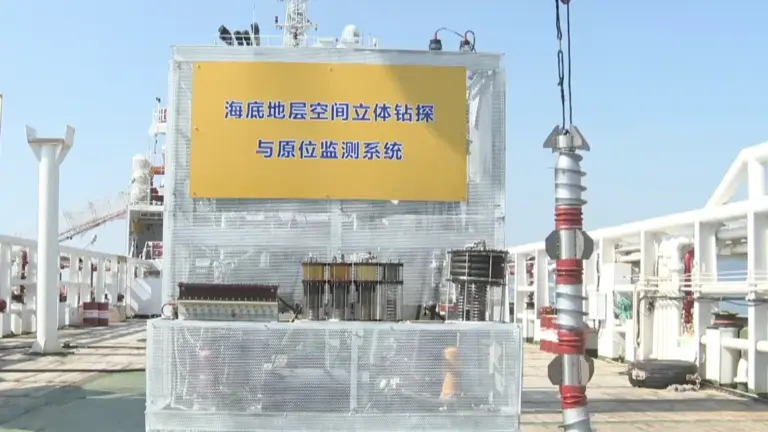
The compact system, about 2.5 meters high and weighing 110 kilograms, combines a drilling module and a set of sensitive sensors. They allow real-time recording of the state of rocks and chemical parameters of the environment.
During the experimental expedition, the robot was lowered to a pre-selected point and performed a series of drilling operations. During his work, he transferred more than two thousand data sets. Scientists received information about the methane content, the level of dissolved oxygen and the structure of subsurface layers. This information is used to evaluate promising areas and clarifying the geological picture of the seabed.
For stable operation in extreme environments, the system was equipped with elements artificial intelligence, inertial navigation and magnetic beacons. This set of technologies helps the device independently choose a route, avoid obstacles and accurately maintain its position while drilling. At a distance of up to 200 meters, the positioning error is less than a third of a meter, and the efficiency of avoiding obstacles approaches 100%.
The design feature is a multi-sectional body that works on the principle of earthworm movement. This allows the robot to change direction, move through dense layers and adapt to the complex topography of the seabed.
The developers intend to modernize the system and use it for exploration of gas hydrates and deep-sea deposits of rare earth elements. The technology is expected to become part of the nation’s deep-sea drilling program and expand China’s ability to explore the resources of the World Ocean.
Source: CGTN
Image: CMG