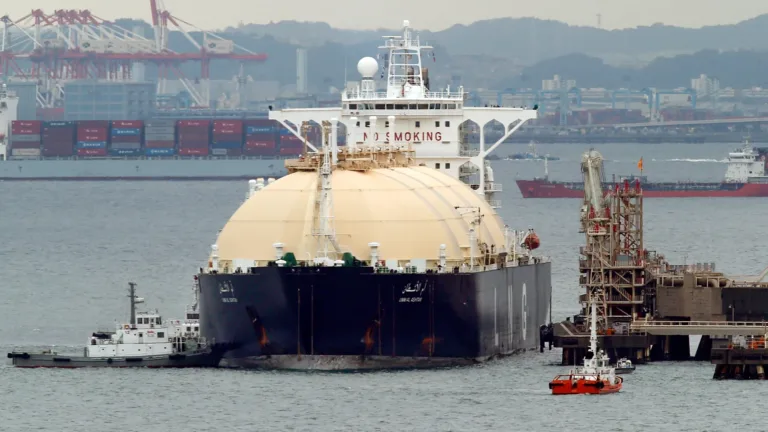
Analysts at Wood Mackenzie warn that an escalation in the Middle East could wipe out projected growth in liquefied natural gas demand in Asia over the next decade. The reason is force majeure declared by the Qatari company QatarEnergy, which controls 20% of the world’s LNG supply. The situation threatens to turn into structural problems.
Gas prices in Europe have already almost doubled since the beginning of March. But the main blow, according to experts, will fall on Asia. It is this region that has been the driver of growth in demand for LNG in recent years. Asia was expected to increase consumption by 200 million tons per year over ten years. Now these forecasts are in question.
The crisis has exposed the vulnerability of countries that rely too heavily on supplies from one region. Buyers will reconsider their approach to long-term contracts, says Wood Mackenzie vice-chairman Gavin Thompson. Even if the infrastructure of Qatar and the UAE is not damaged, the risks associated with the concentration of supplies will force them to look for alternatives.
Can benefit from uncertainty projectswho have not yet made a final investment decision: in the USA, Canada, Mozambique, Argentina, Indonesia, Australia.
Qatar itself and other national companies will most likely begin to diversify their own sources of supply. The market is changing, and relying on one region becomes too dangerous.
In this situation, Asia finds itself between a rock and a hard place. The growth in energy demand has not gone away, but the reliability and price of supply are now in question. In the short term, coal will begin to win its share from gas in the energy balance of Japan, Korea, China, India and Southeast Asian countries. Governments can speed up renewable energy development programs, but this will not give a quick effect. Incentives for domestic production will also not immediately save the situation.
Nevertheless, analysts remain cautiously optimistic. LNG will remain a key element in meeting Asia’s future energy needs; there are simply no alternatives.
Europe will continue to reduce its dependence on gas, but it can no longer decarbonize faster than now – it is limited by budgetary constraints. Return Russian gas in the EU is unlikely, so Europeans will have to put up with high prices for the second time in a decade.
To regain consumer confidence, the LNG market may have to follow the path of oil – creating spare capacity and increasing reserves. This will require huge investments and time, but there is no other way.
For now, the main task is to stop the conflict. And then the industry has a long job to do to restore its reputation as a reliable supplier.
Source: Mining Weekly
Image: Koji Sasahara