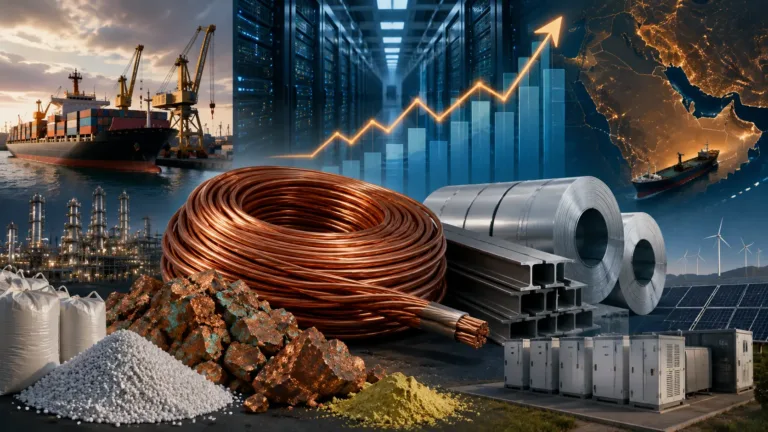
CRU has released its Summer 2026 Metals Market Outlook, forecasting a dramatic increase in copper demand driven by artificial intelligence infrastructure. According to the report, AI data centers will consume 682,000 tonnes of copper, representing a 138% increase compared with the organization’s 2024 forecast. At the same time, renewed conflict in the Middle East and disruptions in the Strait of Hormuz have brought volatility back to global commodity markets.
Steel prices have climbed across Europe as the European Union’s Carbon Border Adjustment Mechanism (CBAM) continues to reshape trade flows. During the first half of 2026, German hot-rolled coil prices rose 10%, while imports of cold-rolled steel into the EU fell by half. With many mills operating below capacity, analysts expect steel shortages to emerge during the third quarter.
The copper concentrate market is facing an increasingly severe shortage of raw material. Treatment and refining charges have fallen into negative territory for the first time, meaning smelters are effectively paying to secure concentrate supplies. For many Chinese smelters, sulfuric acid by-products now account for nearly half of total revenue. Against this backdrop, the mining industry witnessed one of its largest consolidation moves, with the US$63.6 billion merger of Anglo American and Teck.
China has expanded restrictions on battery-related exports, covering not only finished products but also technologies and intellectual property related to cathode materials and graphite anodes. The measures are slowing battery plant development in Europe and the United States. Meanwhile, demand for energy storage systems continues to accelerate. Procurement tenders in China increased 43% during the first five months of the year, while global installed energy storage capacity could exceed 1.2 terawatt-hours by 2030.
The conflict in the Middle East has also disrupted supplies of sulfur and phosphates, with shortages expected to persist through the end of the year. Urea prices have fallen below pre-war levels because of weak demand in the Southern Hemisphere. Potash markets, however, remain relatively insulated thanks to geographically diverse production. BHP has reaffirmed plans to commission its new potash mine in mid-2027, with total investment approaching US$20 billion.
Military tensions reduced aluminum production in the Persian Gulf by an estimated 2.5 million tonnes per year, pushing prices on the London Metal Exchange (LME) to their highest level in four years. However, rapid production increases in Indonesia and China have since eased supply concerns, bringing prices back down. Analysts now expect the aluminum market to move into surplus.
Gold has remained relatively stable, with central bank interest rate policies exerting a greater influence on prices than investor risk aversion. Silver, by contrast, is losing industrial demand due to the slowdown in the solar energy sector and is expected to enter surplus for the first time since 2016.
CRU’s overarching conclusion is that traditional boundaries between commodity markets are rapidly disappearing. Stainless steel prices are increasingly shaped by nickel markets and electricity costs, while cable prices now depend as much on AI data center construction and sulfur markets as on copper itself. The AI infrastructure boom is creating long-term support for many industrial metals, but the report cautions that geopolitical shocks can overturn market forecasts within weeks.
Source: CRU