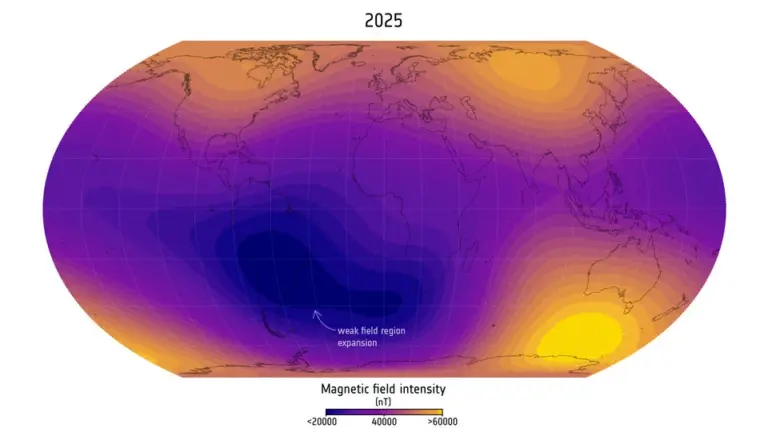
On October 13, 2025, the European Space Agency (ESA) reported new data from the Swarm mission – over 11 years of observations, satellites recorded that a weak magnetic field zone over the South Atlantic, known as the South Atlantic Anomaly, has increased by almost half of Europe.
The Earth’s magnetic field is one of the key shields of our planet. It protects us from cosmic radiation and charged particles from the solar wind. The main source of the field is the movement of molten iron in the Earth’s outer core, which creates electric currents and, ultimately, a magnetic field.
What the Swarm mission shows
The Swarm mission, consisting of three identical satellites, allows scientists analyze magnetic signals emanating from the core, mantle, crust, oceans and upper atmosphere. Thanks to these data, it is possible to understand why the field weakens in some areas, while in others it strengthens.
According to a study published in Physics of the Earth and Planetary Interiors, the South Atlantic Anomaly gradually expanded from 2014 to 2025, and in the area southwest of Africa the field weakened even faster.
“The South Atlantic Anomaly is not a single block,” explains Professor Chris Finlay from the Technical University of Denmark. “It changes differently towards Africa and towards South America. We see how the weakening region under Africa is moving westward, and this is due to the characteristics of the magnetic fluxes between the core and the mantle.”
Why is this important
The anomaly is especially interesting for specialists in space safety: this is where satellites receive increased doses of radiation, which can lead to failures and damage to electronics.
Expert commentary
“The Brazilian anomaly, or as it is also called the South Atlantic anomaly, is a well-known phenomenon,” explains Gleb Zagorsky, geophysicist engineer at the State Research Center of the Russian Federation AARI, an expert in the field of ionospheric research. — People began to actively talk about it in 2011, but a weakening was observed even earlier.
This does not affect humans in any way – there is no beam of radiation “shooting directly from space,” says the expert. – But the electronics of aircraft and especially satellites may suffer. During years of high solar activity, during flares and coronal mass ejections, the radiation load increases, which accelerates the degradation of equipment.”
According to Zagorsky, satellites whose orbits pass through the anomaly – primarily small devices and communication systems like Starlink and OneWeb – are the most vulnerable: “On such days, if the system is not switched to protective mode in time, the device may fail permanently. One interesting thing: even the Hubble telescope goes into protective mode and does not work when flying through this zone.”
Magnetic field dynamics
Swarm data shows that the magnetic field isn’t just weakening—it’s changing on a global scale. For example, in recent years the field has strengthened over Siberia and weakened over Canada, which even affects the position of the north magnetic pole and the navigation system.
“The magnetic field is not just a ‘magnet at the center of the Earth’, but a complex dynamic system,” ESA scientists note. “Only satellites like Swarm allow us to see these changes in their entirety.”
The material was prepared with the support of the Russian Ministry of Education and Science as part of the Decade of Science and Technology.
Source: esa.int