Canadian company Dias Geophysical has brought two new technologies for exploring deep-seated deposits to the commercial market: the DSTX high-power transmitter for the induced polarization method and the QAMT airborne electromagnetic system.
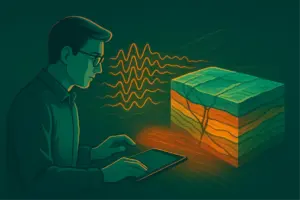
Both developments address one of the key challenges of modern exploration: obtaining information about geological structure at great depths. As the most accessible near-surface targets have already been well studied, exploration programs increasingly require methods capable of probing deeper parts of the section.
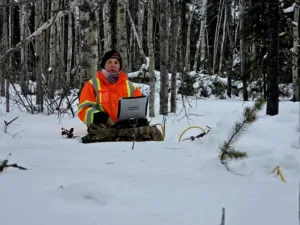
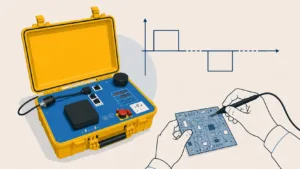
DSTX is designed to work together with the DIAS32 3D electrical survey system. According to the developer, the new transmitter delivers 2.5 times more power than other available systems in its class. A more powerful source makes it possible to increase depth of investigation and obtain data for building more robust models across large exploration areas.
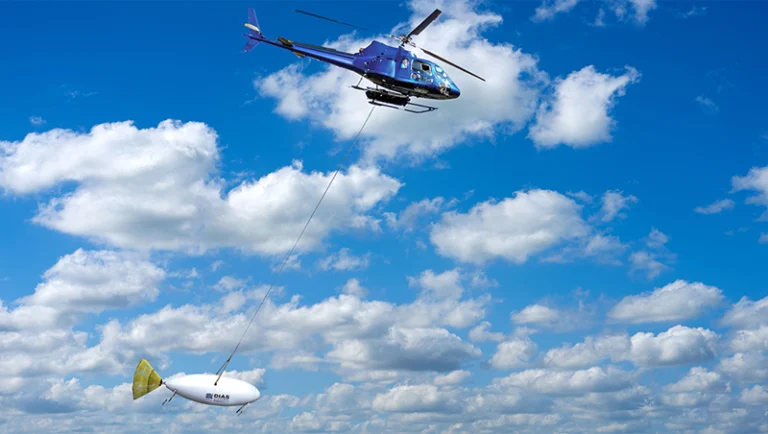
The second technology, QAMT, brings deep electromagnetic surveying into the air. The system is mounted on a helicopter and uses the Earth’s natural electromagnetic fields. At its core are ultra-sensitive SQUID sensors developed by Germany’s Supracon AG. According to Dias, the technology provides information on the distribution of electrical conductivity at depths of more than a kilometer while quickly covering large territories.
For exploration, this is an important trend: advances in instrumentation are gradually widening the range of problems that geophysics can solve before drilling. More powerful ground systems allow deeper investigation of prospective structures, while airborne methods can quickly assess large areas and identify sites for subsequent detailed work.
The developments are aimed primarily at finding mineral deposits, including critical metals. Dias links the development of the new systems to the need to reduce exploration risk and select targets for further drilling more precisely.
Background
Dias Geophysical is a Canadian geophysical company headquartered in Saskatoon. The company develops and applies technologies for geophysical exploration of mineral deposits, including 3D electrical survey systems, electromagnetic methods, and software for data processing and interpretation. Dias works with mining and exploration companies in various countries.
Source: The Globe and Mail Inc.
Image: Dias Geophysical