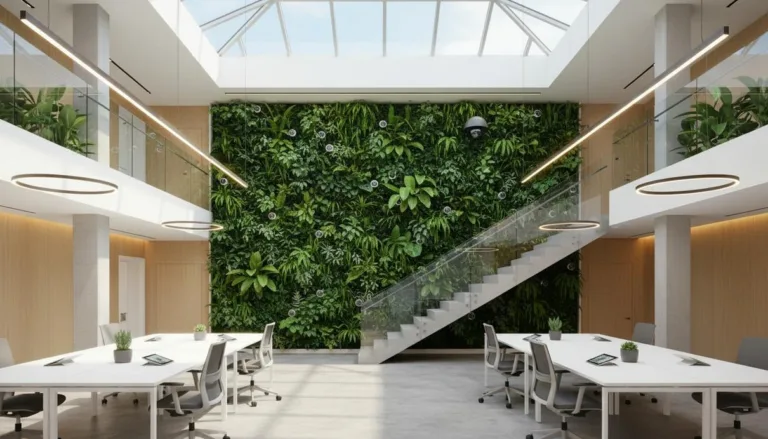
Researchers at the Hebrew University of Jerusalem have developed digital platform, which takes vertical gardens from the category of decoration into the category of predictable engineering infrastructure. The VertINGreen system combines machine learning with remote sensing. It calculates in advance how the plant module will behave in a specific room, and then monitors the health of each leaf in real time.
Modern offices and hospitals spend huge amounts of money on forced ventilation and air filtration. Green walls could take part of this load upon themselves, but until now they could not be “fitted” into the project with a guaranteed result: plants get sick, their activity changes depending on the microclimate, and care requires manual control.
To turn living walls into controllable tools, scientists took almost two thousand measurements of key parameters of popular indoor species. They recorded how much carbon dioxide a particular plant absorbs and how much moisture it releases at different temperatures and light levels. Based on these data, a predictive model was built. Now, even at the design stage, an engineer can calculate how much the load on the air conditioning system will be reduced if a green wall is placed exactly here and of exactly these types.
But control doesn’t end after installation. The platform switches to continuous monitoring mode. Using a hyperspectral camera algorithms detect the smallest changes in leaf tissue long before the plant begins to wither. The system recognizes signs of stress or illness weeks before they become visible to the eye. Moreover, expensive laboratory equipment is not needed for analysis—cameras operating in several spectral ranges are sufficient.
VertINGreen solves two problems at once: it removes uncertainty in design and automates plant care. Green walls cease to be a capricious decoration and turn into a predictable engineering system. For building owners, this means reduced operating costs and the ability to integrate natural elements into the architecture without the risk that after a year the wall will “yellow” and stop working.
Source: Indoor Air
Image: Indoor Air