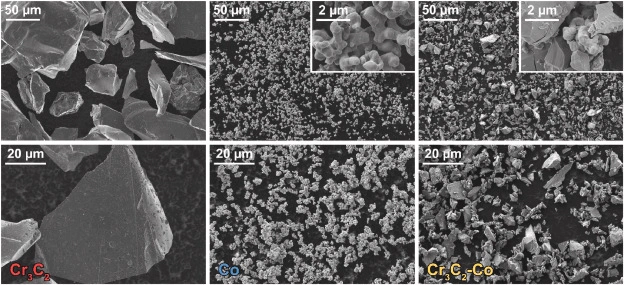
Researchers from the Far Eastern Federal University and Sakhalin State University presented a development that could change the approach to creating key elements of hydrogen plants. Experts have created a ceramic composite based on chromium carbide and cobalt, capable of performing two different tasks depending on the processing mode. The material can be either superactive for acceleration chemical reactions, and exceptionally durable for use in aggressive environments.
The secret of the discovery is the spark plasma sintering method. The powder is compressed under high pressure while powerful electrical impulses are passed through it. In a split second, the temperature rises and the particles fuse into a monolith, maintaining a fine-grained, homogeneous structure. By varying the sintering temperature, scientists obtained materials with opposite characteristics.
When heated to 1200 degrees Celsius, cobalt fills all the microvoids between the chromium carbide grains. The result is a super-dense composite with a hardness of about 1,500 Vickers units – this is comparable to armor steel, but the material is resistant to corrosion. This option is suitable for parts that have been operating in sea water or chemically aggressive environments for years.
If sintering is carried out at 1000 degrees, the structure retains microporosity. The active surface area increases sharply, which greatly accelerates electrochemical reactions, including the release of hydrogen. This version of the material is ideal for electrode coatings in fuel cells and electrolyzers where high performance is important.
One of the authors of the work, Candidate of Chemical Sciences Oleg Shichalin, explained that the data obtained make it possible to design gradient composites: one zone of the product can be made of an active material, the other of a heavy-duty one. This opens the way to creating elements, combining opposite properties in one node.
The development of the Far Eastern team gives engineers a flexible tool: by changing the sintering temperature, they can “customize” the material for a specific task. In the future, this will speed up the creation of efficient and durable devices for hydrogen energy, bringing closer the transition to clean fuel.
Source: Ministry of Education and Science of Russia
Image: FEFU