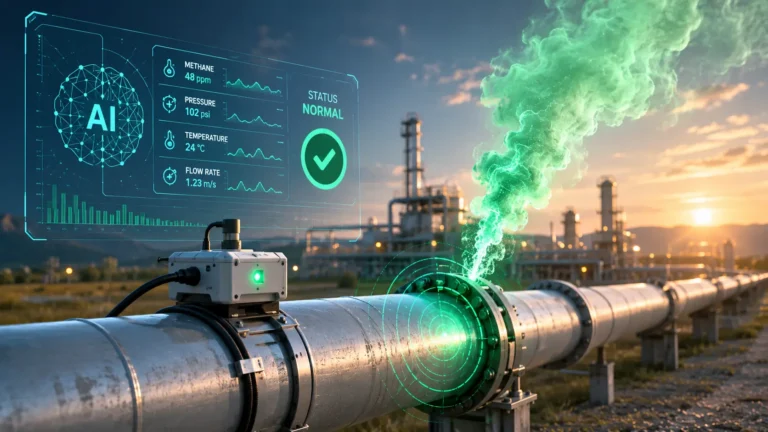
The MethaneGuard AI system can not only detect a methane leak in a gas pipeline but also assess its severity—from a minor defect to a major emergency. Developed by researchers at the University of Petroleum and Energy Studies (UPES) in India, the system was trained on 1,000 simulated scenarios and has demonstrated results that conventional monitoring methods cannot provide.
Gas pipeline condition is typically monitored manually using pressure sensors, acoustic systems, and expensive optical equipment. These approaches require personnel and specialized equipment on site, can struggle to detect slowly developing defects, and rarely determine the severity of a problem automatically.
The Indian algorithm takes a different approach. It continuously monitors four parameters: methane concentration, pressure, temperature, and gas flow rate. Based on these measurements, the system classifies pipeline conditions into four categories: normal operation, minor defect, moderate incident, or major emergency.
Because real-world accident data are difficult to obtain, the developers generated 1,000 simulated sensor records. Half represented normal operating conditions, while the remainder were divided among different levels of severity. The simulation follows a straightforward principle: as a leak becomes more serious, methane concentration rises while pressure and flow rate decline. Under normal conditions, for example, methane concentration was set at 48 ppm and pressure at 102 psi. In a severe-defect scenario, these values changed to 78 ppm and 84 psi, respectively.
The random forest algorithm delivered the strongest results. Classification accuracy reached 93.67%, with a false-positive rate of just 2.47%. The system detected major leaks with near-perfect accuracy, correctly identifying 29 of 30 cases. Minor defects proved more challenging: of 75 cases, 67 were classified correctly, while four were incorrectly classified as normal and another four were assigned to the moderate category.
Methane concentration proved to be the most important diagnostic variable, accounting for nearly 59% of the model’s feature importance. Pressure contributed 24.5%, gas flow rate approximately 14%, while temperature had almost no influence on the classification.
The algorithm processes sensor readings in milliseconds, compared with several hours or even a full day for some conventional monitoring procedures. The developers have also created a web dashboard displaying sensor readings and the current threat level in real time. When abnormal values are detected, the system automatically alerts the operator.
For now, MethaneGuard AI remains a software prototype trained on synthetic data. Real-world pipelines are more complex and conditions can vary significantly. The next stage will involve connecting physical sensors and testing the algorithm at operating pipeline facilities. If those trials are successful, MethaneGuard AI could become a standard component of the Industrial Internet of Things (IIoT) in the gas industry.
Source: Global Energy Association