Scientists have compiled 25 years of observations from across the planet for the first time, covering environments ranging from polar deserts to high-altitude plateaus. The findings are concerning: the active layer of permafrost that thaws each summer is becoming thicker in almost every region. This represents a growing threat to buildings, transportation infrastructure, and the climate of entire regions.
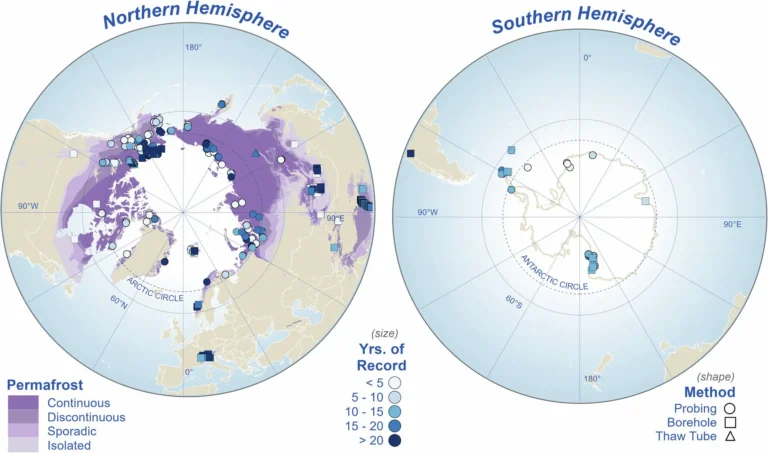
The large-scale assessment was led by Professor Dmitry Streletskiy of George Washington University. The study incorporated data from 156 monitoring sites across the Arctic, Antarctica, and mountain ranges in both the Old and New Worlds. The research was published in Communications Earth & Environment.
The term “active layer” refers to the upper part of the ground that thaws each summer during the short warm season. When this layer becomes thicker, it indicates that heat is penetrating farther into the ground and that the permanently frozen layer beneath it is beginning to lose stability.
The figures are striking. More than half of Arctic monitoring stations recorded a significant increase in active-layer thickness. In Antarctica, the trend was observed at almost 40% of monitoring sites. In the mountain ranges of Europe and Asia, however, more than 90% of stations detected changes. In some locations, the thickness of seasonally thawed ground has doubled.
The main drivers are rising temperatures and more frequent rainfall. Liquid precipitation penetrates the ground more effectively than snow and can deliver additional heat into the soil. At the same time, monitoring coverage remains uneven. The Arctic has been extensively monitored for decades, while Antarctica and many mountain regions remain comparatively poorly studied.
The potential cost of inaction is high. Building foundations, runways, power transmission towers, and gas pipelines all depend on stable permafrost. Preliminary estimates suggest that by the middle of the century, up to half of Arctic infrastructure could face a high level of risk, with potential damage running into tens of billions of dollars.
There is also a powerful climate feedback mechanism. Permanently frozen ground contains enormous amounts of organic carbon. As permafrost thaws, this material decomposes and releases greenhouse gases into the atmosphere, further accelerating global warming. The cycle reinforces itself.
Permafrost is proving to be far less permanent than its name suggests. Its degradation is occurring faster than many models have projected. Every additional centimeter of active-layer thickness means less stability for infrastructure and potentially more greenhouse gases entering the atmosphere.
Source: Communications Earth & Environment
Image: Communications Earth & Environment