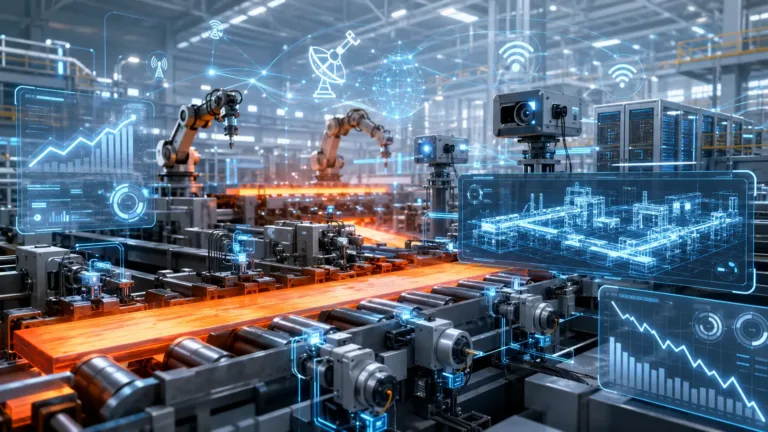
In 2023, the Russian industrial Internet of Things market reached 144 billion rubles. The number of enterprises that had implemented IoT solutions exceeded 36,000. Over the next two years, the trend strengthened: companies actively moved toward AIoT technologies, which combine artificial intelligence and the Internet of Things, and began creating digital twins — virtual copies of equipment and workshops that make it possible to test scenarios without interfering with real production processes.
Experts at MegaFon ProBusiness calculated the return on these investments. In 2023, businesses allocated around 13% of their IT budgets to IoT development and implementation. The effect was twofold: revenue increased by 30%, while operating costs fell by an additional 17%.
What is driving interest in industrial IoT in Russia? First, intense competition is pushing companies to automate and digitalize production. Second, the acute shortage of skilled workers is forcing businesses to replace manual labor with robots and algorithms. Third, the departure of Western vendors has accelerated the development of domestic IoT platforms. Fourth, the infrastructure itself is expanding: narrowband Internet of Things networks (NB-IoT), 5G and satellite communications are spreading. Finally, from 2024 to 2030, the state plans to allocate 90 billion rubles to this area.
One clear example of successful implementation is Severstal. The steel company developed Avtotemp 2.0, a machine-learning-based system. It controls rolling speed and the timing of slab discharge from furnaces at mill 2000 of the Cherepovets Steel Mill. The result is significant: the shop produces an additional 5,500 tonnes of rolled steel every month. The pause between slabs has been reduced by one second. In 2023 alone, this project brought the enterprise 184.5 million rubles in additional profit.
Russian industrial IoT is showing not just quantitative growth, but measurable economic efficiency. Companies that introduce smart technologies gain a competitive advantage through higher revenue and lower costs. Severstal’s example shows that even a one-second optimization can generate millions of rubles in additional profit.
Source: TelecomDaily