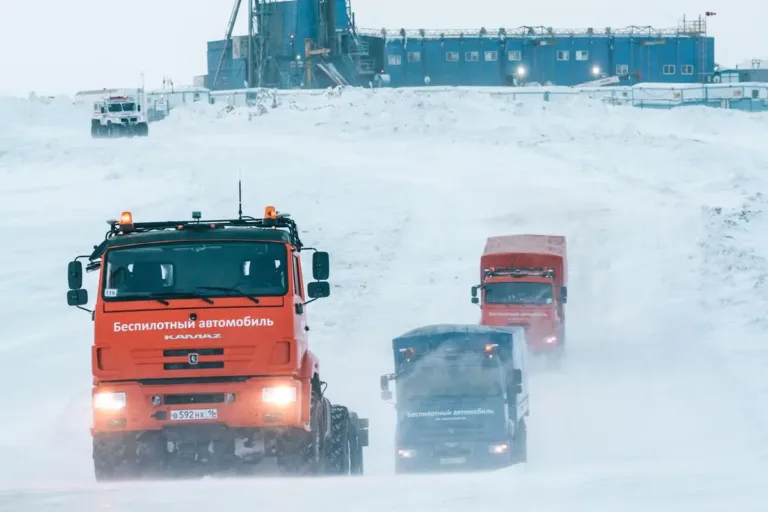
Gazprom Neft has put around two dozen autonomous truck tractors into industrial operation. The vehicles are already delivering equipment to production sites in the Yamalo-Nenets Autonomous Okrug, Yugra and Yakutia. This is the first stage of a large-scale project that the company spent five years testing on eight types of unmanned vehicles and four autonomous driving systems.
The trials took place in Eastern Siberia on difficult interfield roads with elevation changes and extremely low temperatures. Engineers tested algorithms for obstacle detection, anti-skid systems and course stabilization on slippery sections. The result was a platooning technology — an “electronic trail” system in which several trucks move in a convoy behind a lead vehicle, maintaining distance and responding to obstacles on their own.
Each all-wheel-drive AMT tractor, produced by the Miass Automobile Plant, has a payload capacity of 24 tonnes. The vehicles are equipped with lidars, cameras and onboard computers powered by artificial intelligence. The system does not require a stable satellite signal or internet connection: navigation, distance control and obstacle detection are handled by sensors and cameras. The tractors are adapted to all types of roads and the harsh Arctic climate.
According to the company, switching to autonomous logistics can reduce equipment transportation costs by one third, or 33%, while also improving the reliability of deliveries to hard-to-reach areas. Unmanned convoys are already operating in regular mode.
Gazprom Neft’s project shows that autonomous transport in the Far North is no longer a novelty. It is becoming a practical tool that reduces dependence on the human factor, saves money and helps keep production sites running reliably in the harshest conditions.
Source: Gazprom Neft
Image: Gazprom Neft