The attacks on the Ras Laffan terminal and the blockage of the Strait of Hormuz led to a complete shutdown of liquefied natural gas production in Qatar. The situation in the Persian Gulf has hit the most vulnerable link in the world energy sector – the gas market. Unlike oil, which consumers have in reserves for months, gas cannot be stored in such volumes, and any disruption in supply instantly affects prices.
Qatar, together with other countries in the region, provides about 16% global LNG production. A shortage at one point inevitably spreads throughout the planet. Asian importers, sensing a shortage, begin to buy up any available quantities. Already, cargo from West Africa that would normally go to Europe is being redirected to Asia. European hubs react with an immediate rise in prices.
The dependence of EU countries on LNG is uneven and is determined by the availability of regasification terminals. After the withdrawal of Russian pipeline gas, some states found themselves completely dependent on sea supplies.
Portugal and Spain are in the critical risk zone. Lisbon uses LNG for about 90% of its consumption, Madrid for 60%. France, with four terminals, receives more than 60% of its imports in liquefied form. Belgium and the Netherlands, through whose ports gas goes further to Europe, are themselves completely dependent on the operation of the Zeebrugge and Rotterdam terminals.
Germany urgently built floating terminals, which now cover up to half of its needs. Any disruption puts the entire industry at risk. Italy increased the share of LNG to 25–30%, replacing Algerian and Russian gas. Greece and Croatia use liquefied gas as insurance and resell the excess to neighbors. Poland balances supplies from Swinoujscie with its own production and Norwegian gas via the Baltic Pipe.
Even landlocked countries like Austria and the Czech Republic depend on prices from Dutch and German hubs. If France or Germany do not receive their volumes, they will begin to buy back pipeline gas, leaving Central Europe with empty pipes.
West Africa may become Europe’s main savior in this situation. Nigeria, the region’s largest producer, accounts for about 14% of the EU’s LNG imports, but the industry is operating at only 60-80% capacity due to vandalism and a lack of investment. Angola provides a stable but small flow. Algeria, critical for Italy and Spain, is operating at capacity and requires investment in new fields.
Hope is pinned on the Greater Tortue Ahmeyim deepwater project on the border of Senegal and Mauritania. Floating plants will be able to produce up to 10 million tons of LNG per year in the next two to three years. Equatorial Guinea is steadily shipping shipments, but is looking for gas from its neighbors to load capacity.
The world is entering an era where gas becomes not just a commodity, but a weapon and a hostage to geopolitics. The Qatar crisis has shown that the LNG supply chain is much more fragile than the oil one, and the price of this fragility is already included in European prices.
Source: @cdutek
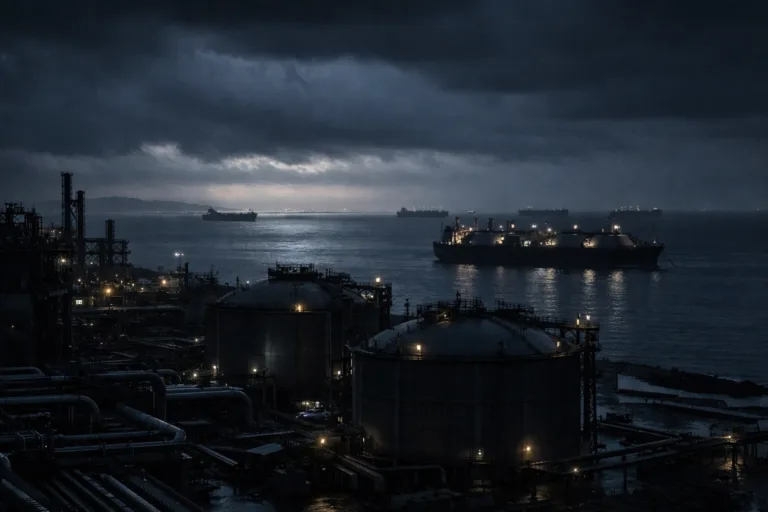
Image generated by a neural network