A new digital development makes it possible to accurately calculate the thermal impact during the production of viscous oil, preventing the melting of permafrost. This reduces risks to the infrastructure and ecology of the Arctic.
Russian scientists have presented a unique computer model that solves one of the most difficult problems of Arctic oil production. Innovation allows for safe development deposits in permafrost conditions, preventing its melting.
As Minister of Natural Resources Alexander Kozlov noted, without the development of Arctic reserves, the country may face a drop in oil production. A special feature of Arctic oil is its high viscosity, due to which it cannot flow into the well on its own. The traditional method using hot steam often leads to heating of the soil and thawing of permafrost.
Melting permafrost threatens the entire oil production infrastructure: well collapses, equipment damage and impacts on the fragile Arctic ecosystem are possible. Previously, special heat-insulating pipes were used to solve the problem, but it was difficult to accurately calculate the required protection.
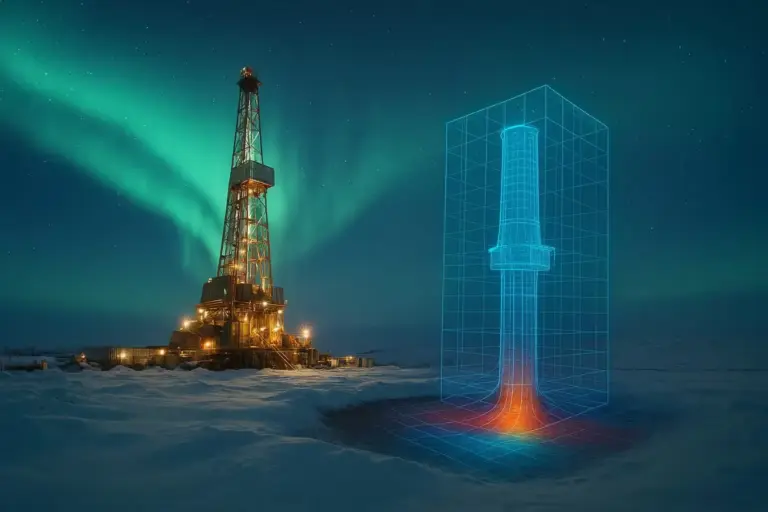
The new virtual model, created by PNIPU specialists, acts as a digital twin of a real well. It accurately simulates the temperature distribution under different operating modes, including intense heating up to 273 degrees. The calculation error does not exceed 5%.
The effectiveness of the model was tested using data from the Usinskoye field in the Komi Republic. This area was chosen due to difficult conditions: the presence of eternal permafrost, viscous oil reserves and problems with paraffin deposits in pipes. The latter are especially dangerous – when cooled, paraffins harden and can completely block the flow of oil.
The development of Russian scientists is especially relevant against the backdrop of climate change. Satellite observations show a steady decline in Arctic ice. At the same time, the share of Arctic oil in Russia’s total production exceeds 20%. The new model makes it possible to develop deposits without damaging the fragile ecosystem of the region.
The material was prepared with the support of the Russian Ministry of Education and Science as part of the Decade of Science and Technology.
Source: @cdutek
photo: www1.ru