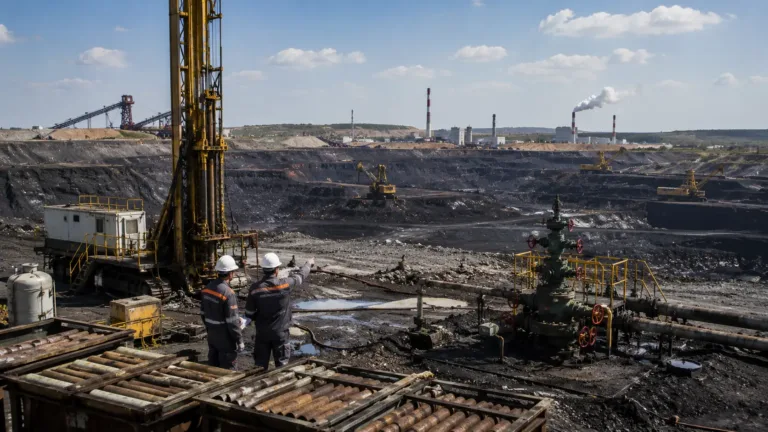
Kazakhstan is preparing to breathe new life into one of its historic coal-producing regions. Vast reserves of methane lie beneath the Karaganda Basin, yet the resource remains largely undeveloped. The Ministry of Energy now plans to open the door to investors by introducing a simplified licensing framework.
Details were announced by Vice Minister of Energy Erlan Akbarov during a coal industry forum held as part of the Astana Mining & Metallurgy Congress. According to Akbarov, the Karaganda Coal Basin alone contains more than 2 trillion cubic meters of gas. Methane content reaches up to 25 cubic meters per tonne of coal, making it one of the richest coalbed methane accumulations in the world.
The main challenge is the limited understanding of the gas-bearing formations. While the coal deposits themselves have been extensively explored, methane resources have received relatively little attention. To address this, the government plans to classify the basin as an underexplored territory. This designation would allow subsoil users to obtain licenses through a simplified procedure similar to the one already used for certain oil projects.
Akbarov also challenged two common misconceptions about the region. The first is that Karaganda coal is too dense to allow commercial gas extraction. In reality, the basin is geologically heterogeneous, and deeper formations contain zones with sufficient permeability. The Sherubaynurinsky area serves as a good example, with methane content ranging from 22 to 25 cubic meters per tonne and permeability levels suitable for industrial production.
The second misconception is that previous methane extraction efforts were unsuccessful. At the Sherubaynurinsky site, eight wells were drilled and core samples were tested in China, Poland, the United States, and Russia. Screening studies and exploration work were completed, but the project never advanced to pilot production, a phase that typically requires between 18 months and three years. As a result, the field’s full commercial potential was never conclusively assessed.
Before large-scale development can begin, Kazakhstan must further refine its regulatory framework. This includes establishing reserve estimation methodologies, creating dedicated provisions within subsoil-use regulations, and developing environmentally acceptable standards for handling produced water.
For decades, the Karaganda Basin’s methane resources have remained largely untouched. Easier access to licenses and targeted legislative reforms could transform the region from a traditional coal center into a major source of natural gas production.
Source: inbusiness.kz
Image: AI-generated