Major players in the global steel industry have achieved a significant breakthrough in low-carbon steelmaking. Industrial trials in China have demonstrated that the steel of the future does not require scarce, high-grade iron ore concentrates. Standard iron ore from Australia’s Pilbara region can do the job.
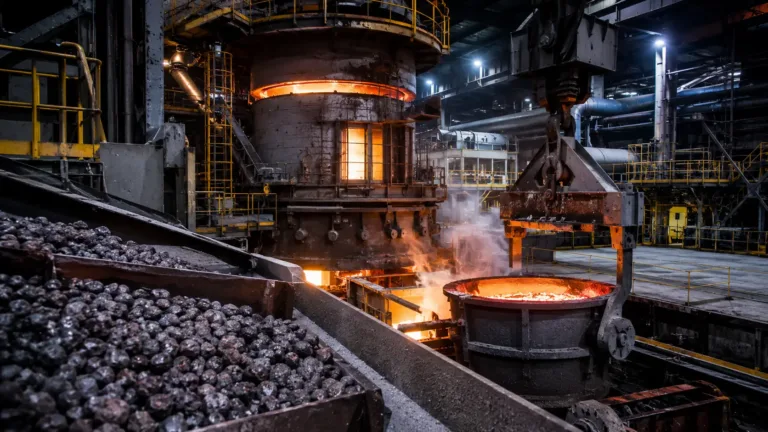
The tests were conducted at Baoshan Iron & Steel’s plant in Zhanjiang. Engineers fed a hydrogen-based shaft furnace with iron ore pellets containing approximately one-third Pilbara Blend ore. The results exceeded expectations, successfully producing direct reduced iron (DRI).
The experiment did not end there. The resulting iron was tested in two different steelmaking routes: a basic oxygen furnace (BOF) and a small electric arc furnace (EAF). Both processes confirmed that the technology works effectively without requiring major modifications to existing steelmaking infrastructure.
The key conclusion is particularly important for the industry. Until now, hydrogen-based iron reduction was widely believed to require expensive and scarce high-grade iron ore. The trials have demonstrated the opposite: medium-grade ore can perform successfully in hydrogen-based processes. This removes one of the major obstacles to decarbonizing the steel sector.
Rio Tinto and China Baowu have been collaborating on decarbonization research since 2020. The latest achievement is considered one of the most significant outcomes of their partnership. It opens the door to large-scale adoption of hydrogen direct reduction technology without fundamentally changing established steelmaking routes or relying entirely on limited supplies of premium-grade ore.
Green steel is now one step closer to widespread commercialization. If conventional iron ore can be used in hydrogen metallurgy, the transition to cleaner steel production becomes far more accessible and has the potential to evolve into an industry standard.
Source: @nerzhavey
Image: AI-generated