Magnetite, hematite, brown iron ore, siderite – to the uninitiated, this sounds like a set of spells. It’s difficult to remember everything at once: what is it, different names for the same rock? Let’s figure out what types of iron ore there are and what features are important for geologists, geophysicists and metallurgists.
What are iron ores and what are they?
Iron ore is not a separate mineral, but a rock from which it is economically feasible to extract iron. “Pure” metal is almost never found in nature. Industrial interest represent namely iron-carrying minerals.
Most often these are oxides, hydroxides and carbonates: magnetite, hematite, goethite, siderite and their combinations. The ores get their names based on their dominant mineral, and when they talk about types of iron ore, they usually mean differences in mineralogical composition.
To avoid confusion, geologists, miners and metallurgists use several levels of classification. In practice, iron ores differentiate:
- in composition – magnetite, hematite, brown iron ore, siderite;
- by origin – igneous, carbonatite, skarn, hydrothermal, weathering, sedimentary oolitic, metamorphogenic ferruginous quartzites;
- according to the form of the industrial product – concentrate, pellets, agglomerate, direct reduced product.
These classifications are needed for different tasks. Mineralogical composition is important for assessing washability and metallurgical properties, origin – for searches and forecasting of deposits, and product form – for logistics and industrial processing.
Read also:
— Gravity reconnaissance method or why we flew a helicopter over the Yukon
— How to find lithium-bearing pegmatites by ground gravity exploration
Main types of iron ores
In applied geology most often allocate 4 types of iron ore. Below is a short description of each of them.
Magnetite ores
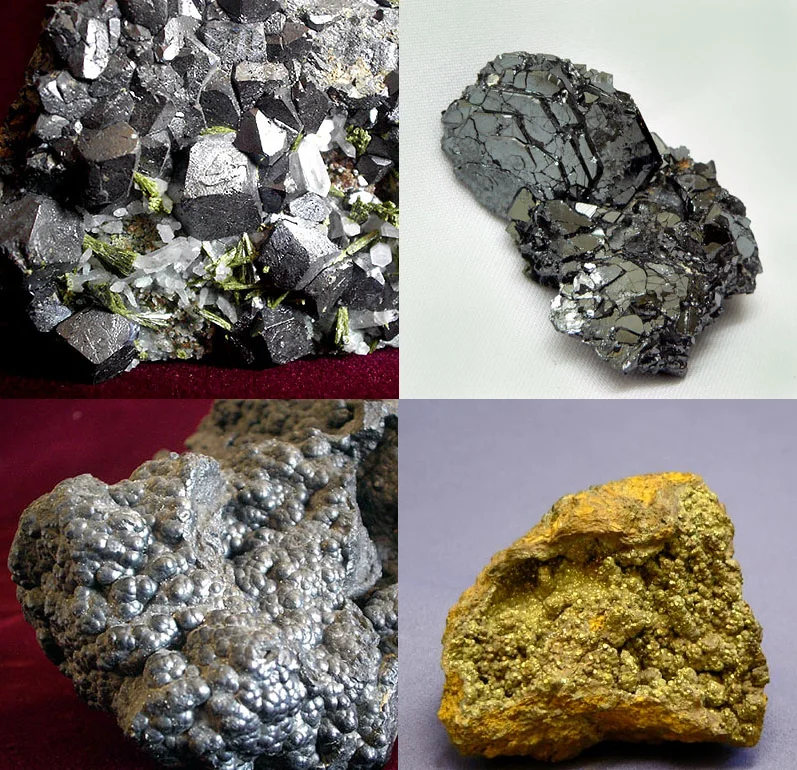
Magnetite is a black or dark gray mineral with a metallic luster. These ores are easy to recognize in the field. Samples are attracted by a magnet, sometimes literally “sticking” to it. Due to this, geophysicists have a clear view of magnetite ores, which confidently appear in magnetic and gravity data.
The main advantage of magnetite is its good workability. Even if the original ore is not very rich, magnetic concentration allows you to obtain a stable concentrate. Magnetite is present at the Kiruna mine in Sweden and the Kovdor deposit in the Murmansk region.
Hematite ores
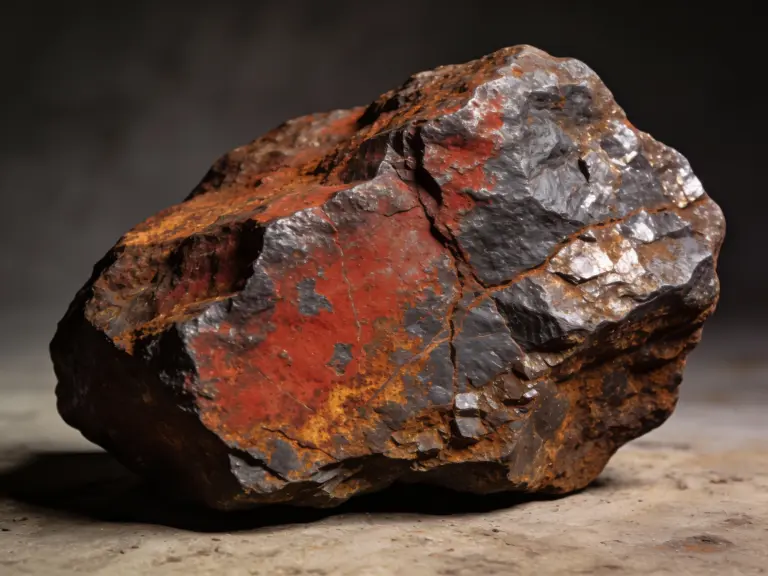
Hematite is a mineral that is often called blood red ironstone due to the characteristic features on the chip. It is one of the main sources of iron in the world and a valuable raw material for metallurgy. It is found in the mines of North America, Kazakhstan, Russia, Italy, Brazil and other countries.
If there are few impurities, hematite becomes the main industrial type of iron ore and is often used with minimal beneficiation. When the composition is heterogeneous, processing schemes for enrichment are selected individually for each deposit.
Brown iron ores (goethite-limonite ores)
Brown iron ores are porous, often friable ores with yellow-brown, rusty tints. From the point of view of mineralogy, they are represented by iron hydroxides – goethite and limonite, which are found in the Bakal deposit (Southern Urals) and the Lipetsk iron ore deposit.
The main advantage of brown iron ore is its close occurrence to the surface and ease of extraction. But this comes at the cost of lower iron content, higher moisture content and limited enrichability. Brown iron ores are often mined in the early stages of field development and are replaced by richer ores at depth.
Siderite ores
Siderite is an iron carbonate, an inconspicuous and usually non-magnetic form of iron ore. It contains a significant proportion of carbon dioxide, which makes processing difficult and energy-intensive.
For this reason, siderite ores are used less frequently than others. Most of the deposits have already been developed, but traces of the mineral are found in such Russian deposits as Akhtinskoye and Bakalskoye (Urals) or Angaro-Pitskoye (Eastern Siberia).
| Type of ore | Main mineral | Typical Fe content | Key property | Peculiarities |
| Magnetite | Magnetite (Fe₃O₄) | 72,4% | Magnetic | Well enriched, stable concentrate |
| Hematite | Hematite (Fe₂O₃) | 70% | Non-magnetic, dense | Often rich, direct melt possible |
| Brown iron ores | Goethite (HFeO2), limonite (FeO2 H2O) | 52,0–62,9% | Porous, wet | Easy to mine, low quality raw materials |
| Siderite | Siderite (FeCO₃) | 48,3% | Carbonate | Requires firing, high energy intensity |
Main differences between types of iron ores. Source: Rosmining
In practice, the types of iron ores are closely connected with types of deposits and conditions of ore genesis. Thus, sedimentary and oolitic deposits are often represented by brown iron ores, and igneous and metamorphic objects may contain rich magnetite bodies. If you know this connection, you can quickly evaluate prospects of the object, choose the exploration method and processing scheme.
When deposits near the surface have already been found, it’s time to dig deeper and connect geophysical methods for searching for minerals
Why even know the types of iron ore?
For a geologist and geophysicist, knowledge of the types of iron ore is a tool. Magnetite bodies typically show up well in magnetic and gravity data due to their high density and magnetic susceptibility, while lignites and siderite ores produce weaker or ambiguous anomalies. This directly affects the choice of exploration methods and the interpretation of results.
A practical example is the Yakovlevskoye field in the Belgorod region (KMA region). The discovery was made almost by accident. There was no purposeful search for iron ore here: the magnetic anomaly was weak, the area was considered unpromising, and it was not even highlighted on the maps. Geologists drilled in search of coal. And only in 1953, at a depth of more than 500 meters, a drill unexpectedly uncovered a powerful body of rich iron ore.
“Billions of tons of ore lie underground; there are more reserves than in the entire Krivoy Rog basin! And at the same time, the quality of the ore is very high – its iron content exceeds 60% of pure iron,” remembers chief geologist of the Belgorod iron ore expedition Semyon Chaikin.
It is in such situations that the question “What kind of ore is this?” – one of the first for geologists and miners.
With which types of iron ore did you encounter it in the field or during enrichment? Particularly interesting are cases when ore that seemed unpromising at first glance became profitable.