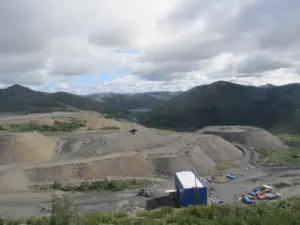
Today Canada is one of the largest suppliers of diamonds in the world. Millions of carats are mined here every year, and the stones are valued for their purity and transparency. But in the late 1980s, all this seemed impossible: there were no roads or oil fields in the Arctic wilderness.
History was turned upside down by Canadian and Russian pioneers – Chuck Fipke, Stuart Blusson, Nikolai Pokhilenko, Vladimir Shchukin. They began searching where others had already given up. Over the course of a decade, their work transformed the north of the country from a “white spot” into one of the world centers of the diamond industry. Let’s find out how they did it.
North without a chance: geology and logistics versus diamond prospecting
Late 1980s. On the diamond map of the world, Canada is an empty space. Even De Beers made attempts to find kimberlites, but the company left, considering the north of the country unpromising.
Their decision seemed logical. Geology played against the search: thick glacial deposits hid the bedrock, and diamond companion minerals could have been carried tens of kilometers away by ancient glaciers. Finding pyrope does not mean understanding where the source itself is. Without hundreds of samples and complex analysis of ice flows, the work became a game of hot and cold over an area the size of a small country.
Added to this were harsh conditions and logistics: there are no roads, winter roads last only a couple of months, the rest of the time only by helicopter or plane. Frosts, wind and endless lakes turned even one test well into a separate expedition. In such conditions it seemed easier to leave than to continue searching.
How are diamonds formed and why are they searched for by their satellite minerals? – read our article
Starting point: one person’s decision
When the big players had already given up on the northern territories, Chuck Fipke went against the grain. His decision was not a gamble: in samples of glacial sediments, he found rare but key mineral companions of diamonds – pyropes and picroilmenites. The north of Canada is part of an ancient crystalline shield, and world experience suggests that it is in such structures that kimberlite pipes are most often hidden.
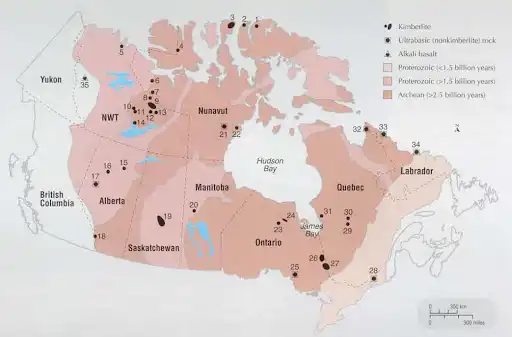
That all changed in the early 1990s, when “live” grains of pyropes and picroilmenites appeared in the Point Lake area—too fresh to have been brought from afar. Fipke and team traced the direction of glacial transport, narrowing the search to a few kilometers. Summer drilling confirmed the hypothesis: a kimberlite pipe with industrial diamonds was hidden under the sediments.
So one decision of one person became the starting point and turning point in the history of Canadian diamonds.
Today, routine search tasks are taken over by artificial intelligence. Read, how a neural network finds deposits that a geologist cannot see
Russian geologists in Canada: new discoveries
After the discovery in the Point Lake area, it became clear that there was more than one kimberlite pipe hidden under the permafrost. In the mid-1990s, Russian specialists, accustomed to working in harsh conditions, joined the search.
Vladimir Shchukin spent three field seasons in Canada, exploring areas where there was no geological data. Focusing only on the relief, he managed to discover two kimberlite pipes in a “clean” area.
Nikolai Pokhilenko, one of the discoverers of kimberlites in Siberia, used a search method using satellite minerals. Already in the first sample he discovered thick purple pyrope and picroilmenite – reliable indicators proximity of kimberlite. This quickly brought his team to a new tube.
Although Shchukin and Pokhilenko worked independently, their discoveries expanded the map of Canada’s diamond-bearing zones and cemented the success of the North American diamond rush.
From a white spot to world leaders
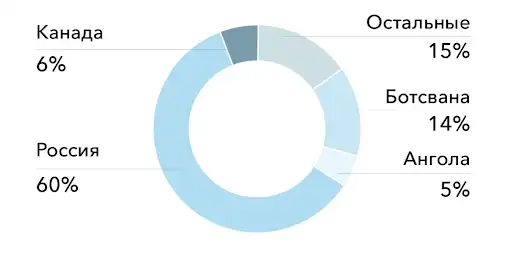
In 1998, the first industrial diamond mine in the country’s history, Ekati, opened in northwest Canada. The path from the first tests to launch took less than ten years – by the standards of the mining industry, this is an instant. Already in the first years of operation, the mine produced millions of carats, and Canada became one of the three largest diamond producers in the world, second only to Russia and South Africa.
Canadian stones have become a sensation on the world market: mining here was carried out according to strict environmental standards, and the products received a reputation for being “clean” and ethical. Seemingly eternal De Beers dominance is under threat, and new players forced the giants to reconsider their strategies.
These discoveries changed not only the market, but also Canada itself, which in one decade turned into one of the world leaders in diamond mining. And it all started with the persistence of several people who decided to look where others had long ago given up. The story of Canadian diamonds is a reminder that the persistence and determination of individuals can change the fate of an entire country and even the global market.
Cover photo: Burgundy Diamonds Media Gallery