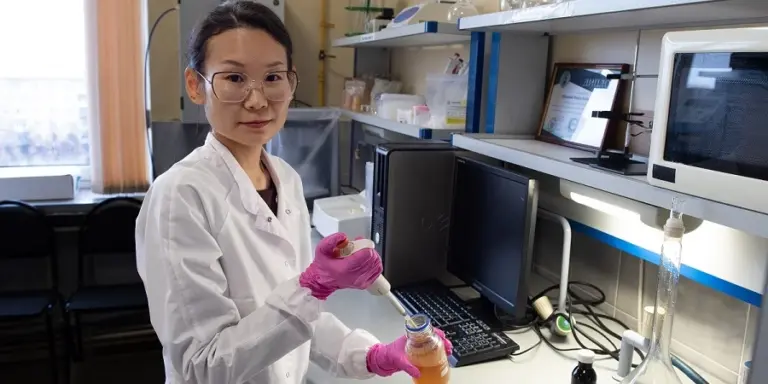
Specialists from Russia have developed the world’s first drug that can effectively eliminate ultra-fine oil spills in warm seas. The new tool solves a problem that has long been considered virtually insoluble.
Scientists from the Gubkin Russian State University of Oil and Gas, the Institute of Petrochemical Synthesis of the Russian Academy of Sciences and the Russian-Vietnamese Tropical Center created a reagent called CH-1. Its key task is the elimination of oil films less than one millimeter thick. Such contaminants cannot be collected using conventional methods and are extremely difficult to neutralize.
The problem of spills in tropical latitudes is particularly acute. High water temperature makes oil more fluid, it spreads into an almost invisible film. Traditional methods of collection and burning do not work in such conditions. However, the development of scientists is not limited to the tropics. The new reagent is a game changer. It is applied along the border of the spot and causes it to “shrink”, increasing its thickness tens of times. As a result, dense clumps of oil form on the surface of the water, which can already be removed using standard means.
The drug CH-1 is created on the basis of pentanol and isobutanol – safe components that are widely used in cosmetics and pharmaceuticals. This minimizes environmental damage, which is critical for the biodiversity of tropical seas. The reagent has been successfully tested in the waters of Vietnam, the South China and Black Seas and is applicable in the seas of the temperate zone. It works stably for more than a day, and its efficiency does not decrease in the rain.
The technology offers the potential for rapid response to spills in sensitive regions, including the Mediterranean and Red Seas, as well as coastal rivers and bays. The development not only collects, but also prepares oil for subsequent disposal, forming the basis for a waste-free process.
The presented innovation is a significant step in protecting the marine ecology. The CH-1 reagent allows you to eliminate those contaminants that previously remained in the water, causing irreparable harm. Now scientists and industrial partners are working to launch industrial production of this unique product.
Source: neftegaz.ru