Scientists have found traces of annual climate cycles in Scottish rocks “Snowball Earth” era, when the planet was almost completely covered in ice.
An international team of researchers from the University of Southampton has found evidence that the Earth’s climate continued to change even during the harshest Ice Age. We are talking about the cryogenic period 720–635 million years ago, when, according to previous ideas, the climate system practically “froze.”
At this time, ice sheets reached the tropics, and the oceans were considered completely frozen. It was assumed that the exchange between the atmosphere and the ocean was stopped for millions of years, and short-term climate fluctuations disappeared.
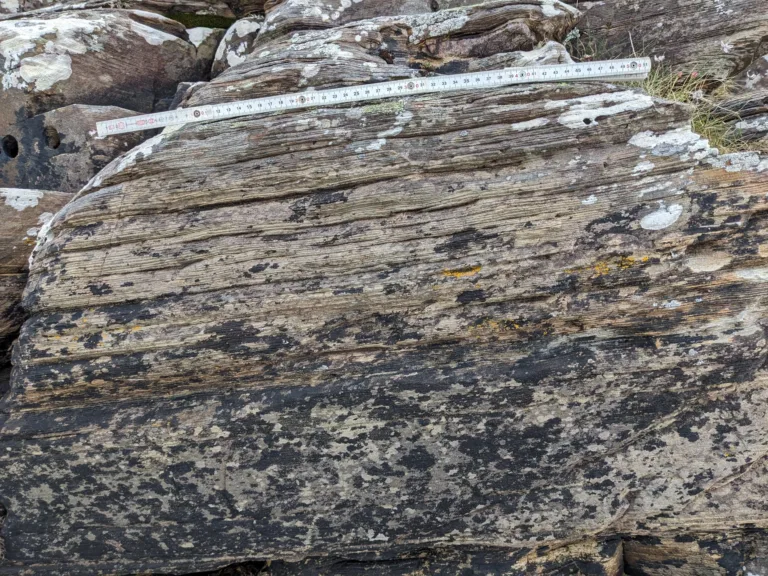
However, analysis of ancient layered rocks on islands off the west coast of Scotland showed a different picture. The scientists studied 2,600 thin layers of sediment from the Port Askaig Formation, each representing one year of accumulation. These rocks were formed during the Stertian glaciation, the longest event, lasting about 57 million years.
Microscopic analysis showed that the layers were formed by seasonal cycles of freezing and thawing under the ice sheet in a calm deep-sea environment. Statistical processing of the thickness of the layers revealed repeating climatic cycles lasting from several years to decades.
According to the researchers, these fluctuations are remarkably similar to modern processes, including analogues of the El Niño cycle and solar activity. This means that even under conditions of global glaciation, the climate system retained the ability to fluctuate.
Simulations of Snowball Earth’s climate showed that even if about 15% of the ocean surface remained ice free, the interaction between the atmosphere and water could resume. Small areas of open water in the tropics were sufficient for the emergence of familiar climate regimes.
Scientists believe that such episodes were rare and short-lived amid a generally stable and extremely cold climate. Nevertheless, it was they who left a trace in the rocks, which we managed to decipher.
The study shows that the Earth’s climate is capable of maintaining dynamics even in the most extreme conditions. These data help to better understand the sustainability of the planet’s climate system and its response to global changes in the past and future.
Source: phys.org
Image: Thomas Gernon