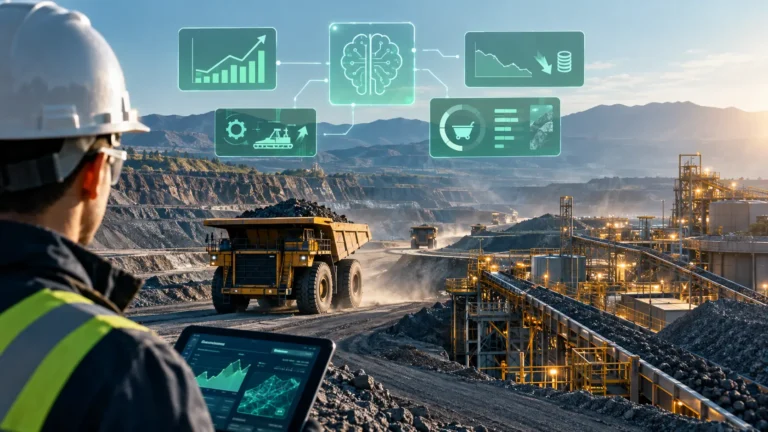
Artificial intelligence has stopped being an experiment in the mining industry. According to McKinsey, 15 of the 19 major companies the consultancy tracks have already reported a financial impact from AI in the third quarter. A quarter earlier, only four had done so. Consultants estimate the technology could lift the industry’s EBITDA by 10–15%.
The effect comes from two components: roughly a 5% increase in production and about a 10% reduction in C1 direct cash costs. Processing leads the way — ten of the nineteen companies reported AI’s financial impact specifically in this segment.
McKinsey partner Ferran Pujol, who oversees the energy and materials practice in Latin America, laid out the key test at the Mining Forum Americas. According to him, a collection of scattered initiatives doesn’t yet amount to transformation. The real test is simple: has production itself changed, rather than just new tools appearing.
An important caveat applies here. McKinsey describes the data collected as “self-reported value” and doesn’t disclose company names or figures. Pujol characterizes the incomplete quarterly snapshot as an initial signal that still needs confirmation. The question is whether companies can sustain the effect, separate it from commodity prices and normal fluctuations, and then replicate it at other mines.
The highest tier of evidence — confirmed in financial statements — was reached only by AI applications for mill and flotation tuning. Computer vision and blend optimization fell into the “proven” category. Leaching and water/reagent optimization are still considered emerging.
In equipment maintenance, the best results came from optimizing scheduling and downtime, with predictive maintenance classified as a proven solution. Freeport-McMoRan’s senior data and AI advisor Ravikanth Malladi warned that the technology won’t help if basic processes aren’t functioning well. If an oil sample never made it to the lab and the data never entered the tracking system, AI can do almost nothing.
Beyond the plant, the evidence base is thinner. Digital twins of mines and plants were classified as proven, while the remaining eight applications — including mine planning, drilling and blasting, dispatch, and autonomous fleets — remain at an emerging stage. All three areas of exploration also remain at an early level.
Microsoft director Akilan Kapilan urged against giving models unchecked decision-making authority. Metallurgists and other specialists need to set boundaries and maintain oversight, since models produce errors when fed unreliable data.
Ivanhoe Mines founder Robert Friedland broadened the discussion: the race for AI will accelerate demand for electricity, copper, and critical minerals regardless of how quickly miners adopt the technology themselves. In his view, AI is developing primarily as a military technology.
The gap between pilots and scaling remains huge: according to a global McKinsey survey, 89% of organizations regularly use AI, but only 44% have deployed it enterprise-wide. Companies that have progressed furthest follow a 70-70-70 rule: keeping 70% of IT talent in-house, favoring developers over coordinators, and drawing 70% of people from senior roles. The main question boards are asking is simple: when will this start making money.
Source: MINING.COM