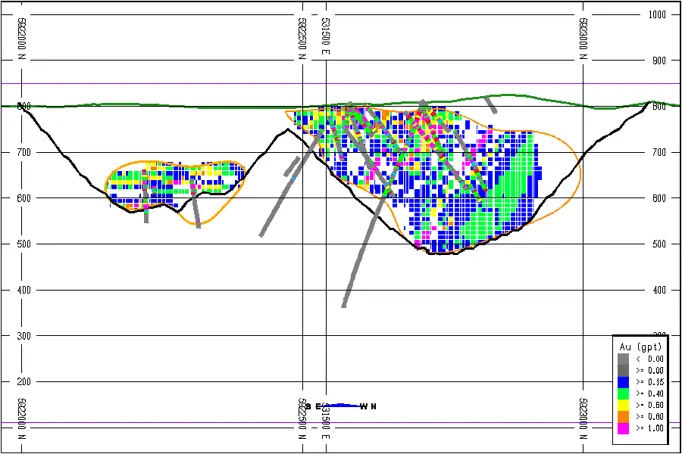
Canadian company Golden Cariboo Resources has released its first resource estimate for the Quesnelle deposit in central British Columbia. Indicated resources total 175,000 ounces of gold, while inferred resources total 995,000 ounces. Despite the solid figures, the company’s shares plunged nearly a third — investors, judging by the reaction, had expected more.
The indicated category accounts for 10 million tonnes of ore at an average grade of 0.55 grams of gold and 1.5 grams of silver per tonne, yielding 175,000 ounces of gold and 494,000 ounces of silver. Inferred resources are estimated at 70.9 million tonnes at grades of 0.44 grams of gold and 1.2 grams of silver, equating to 995,000 ounces of gold and 2.63 million ounces of silver.
The estimate covers the Halo and North Hixon zones and is based on a database of 24 diamond drill holes totaling 8,466 meters. The deposit’s main zone, Main, was not included in the estimate — it has six company-drilled holes plus several historical surface holes.
CEO Frank Callaghan called the result confirmation of the strength of the Halo discovery. The market reacted differently, however: in Toronto, shares fell 31% to nine cents, and market capitalization shrank to roughly CAD 14 million.
Couloir Capital analyst Ron Vortel had previously called the initial resource estimate a key near-term value catalyst for the company. The firm maintained a buy rating and a fair value of 40 cents, while assigning the stock a very high risk rating. Before the resource was released, the valuation had been based largely on comparisons with peers, since Golden Cariboo lacked a standards-compliant estimate of its own.
Background
Quesnelle is located four kilometers northeast of Hixon and about 60 kilometers south of Prince George. It’s part of a 949-square-kilometer land package in the historic Cariboo gold district. The property is adjacent to Osisko Development’s Cariboo project, has year-round road access, and sits along a geological corridor near the Spanish and Eureka faults.
Gold has been sought here since the 19th-century gold rush, and the vein in the Main zone was discovered in 1865. Golden Cariboo describes Quesnelle as a sediment-hosted vein deposit of the epizonal orogenic class.
The company intends to continue drilling beyond the areas included in the initial estimate. The 2026 program calls for about 7,500 meters of drilling, and the new data could form the basis for an updated resource estimate.
Source: Golden Cariboo Resources
Image: Golden Cariboo Resources