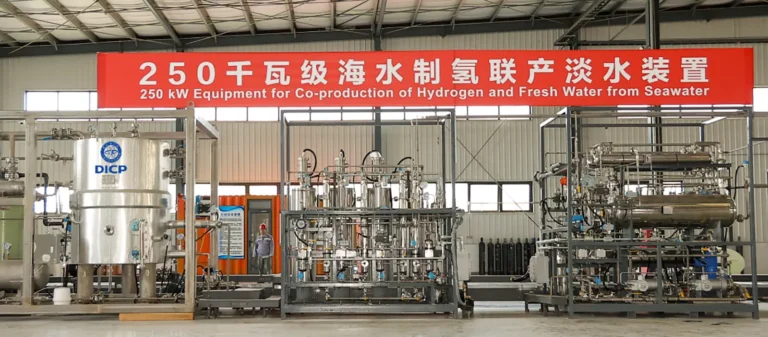
Scientists at the Dalian Institute of Chemical Physics have created a system that simultaneously produces hydrogen and desalinates seawater. Heat generated during electrolysis isn’t wasted but instead used to produce fresh water. The technology was tested on 20-kilowatt and 250-kilowatt units, with results published in the journal Nature Energy.
The development combines alkaline electrolysis with low-temperature vacuum distillation. Seawater first undergoes desalination, and part of the resulting fresh water is then fed into the electrolyzer. This setup provides a dual benefit: it uses the equipment’s waste heat and avoids direct contact between the electrodes and saltwater, which typically causes damage.
The 20-kilowatt pilot unit ran without failures for a hundred days. Each hour it produced 3.8 normal cubic meters of hydrogen and 1.2 kilograms of fresh water. Researchers then scaled up to 250 kilowatts. On this equipment, output reached 48 normal cubic meters of hydrogen and 31.6 kilograms of fresh water per hour.
The combined system’s electrical efficiency was 14.4% higher than that of conventional alkaline freshwater electrolysis. The authors note that this figure applies to the system as a whole and doesn’t imply a proportional increase in hydrogen output.
Concentrated brine remains after desalination. The developers view it as a potential raw material for extracting salt and other components, though the results presented concern only the combined production of hydrogen and water.
One clarification is important: the confirmed hundred days of stable operation apply to the 20-kilowatt version. The paper’s abstract doesn’t specify an equivalent test duration for the 250-kilowatt unit.
The development shows that hydrogen production and desalination can operate within a single cycle, boosting overall efficiency. If the technology proves reliable at larger scales, it could become a solution for regions facing severe freshwater shortages that also need clean energy.
Source: NIA “Ecology”
Image: Chinese Academy of Sciences