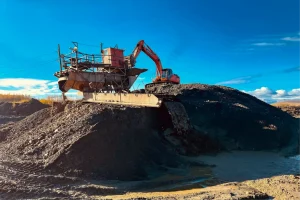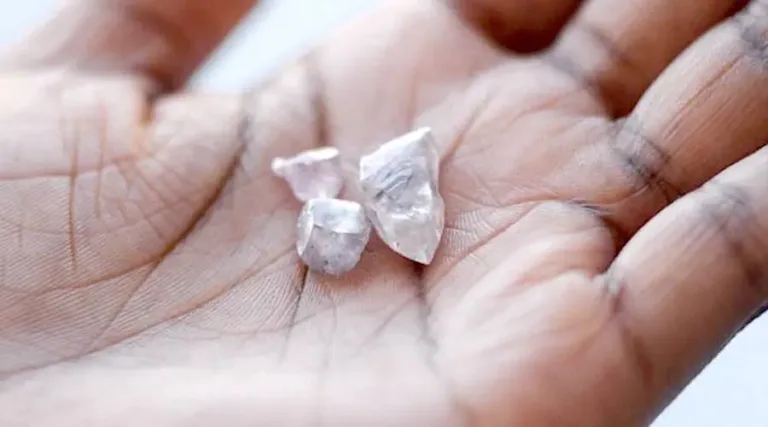
De Beers delivered a striking paradox in the second quarter. The world’s leading diamond producer mined 88% more rough diamonds than a year earlier, yet revenue from sales fell by nearly half. Higher-grade ore and stronger production could not offset collapsing prices and mounting competition from lab-grown diamonds.
Rough diamond production climbed to 7.8 million carats during the quarter, while first-half output increased 46% year over year to 14.91 million carats. The sharp rise was largely due to the comparison with last year, when Botswana’s Orapa mine underwent an extended maintenance shutdown. Production also benefited from mining higher-grade ore at several operations. Output in Botswana doubled to 5.5 million carats, Canada’s Gahcho Kué mine reached 1 million carats thanks to a new mining area, and South Africa’s Venetia mine increased production by 24% as underground operations expanded.
Despite the production surge, financial performance deteriorated significantly. The average realized price for the first half of the year fell 32% to just $105 per carat. According to the company, the decline reflects an aggressive sale of approximately $2 billion worth of accumulated inventory, which consisted largely of smaller, lower-value diamonds.
Revenue from rough diamond sales declined 44% in the second quarter to $665 million, even though sales volumes slipped by only 7% to 7.1 million carats. For the first six months of the year, sales volumes rose 20% to 14.78 million carats, while revenue dropped 23% to $1.31 billion.
De Beers attributes the weak market to a combination of geopolitical and macroeconomic uncertainty—including the conflict in the Middle East—which has dampened consumer confidence. At the same time, laboratory-grown diamonds continue to capture market share in the lower-priced jewelry segment. Prices for larger, higher-value stones have remained comparatively resilient, preventing an even steeper decline in the overall market.
Meanwhile, parent company Anglo American continues negotiations to sell its 85% stake in De Beers. A consortium led by former De Beers CEO Gareth Penny has emerged as the preferred bidder. The government of Botswana, which owns the remaining 15%, is reportedly considering exercising its pre-emptive rights and increasing its ownership stake. At the operational level, De Beers is preparing to suspend production at the Venetia mine for two years as part of its cost-cutting strategy. However, the company has maintained its annual production guidance of 21–26 million carats, while noting that further reductions remain possible if market conditions deteriorate.
Record production alongside sharply declining revenue illustrates the depth of the diamond industry’s current downturn. De Beers is reducing costs and liquidating inventories as Anglo American seeks a buyer for a business that has lost much of its former shine.
Source: MINING.COM
Image: De Beers