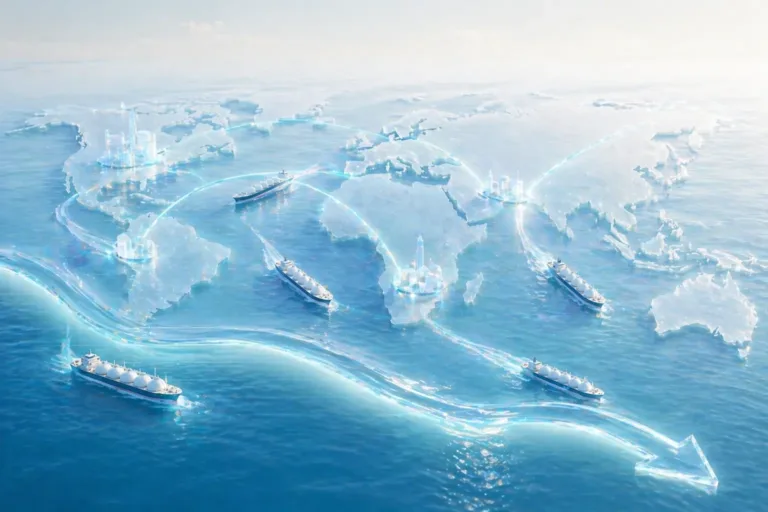
The International Energy Agency expects the global market to reach a surplus by the end of 2026 liquefied natural gas. New projects in the USA, Qatar, Canada, Mexico and Congo will add a total of 40–44 billion cubic meters of LNG per year. However, analysts warn that prices may not fall as much as we would like due to geopolitics, technical delays and weather anomalies.
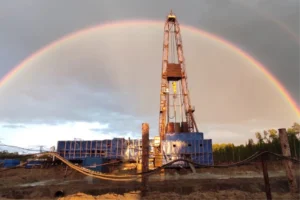
The main increase – about 65% – will be provided by the USA and Qatar. The first line with a capacity of 6 million tons was launched in Texas a month ago. Full commercial shipments will begin in the second quarter. In Louisiana, the plant is gaining momentum: the peak of the project is up to 35 million tons per year.
Qatar is expanding its North Field East. The first 32 million tons per year will be launched at the end of 2026, but the main effect will be felt in 2027. By 2030, Qatar plans to almost double its capacity from 77 to 142 million tons per year.
Canada opens LNG Canada’s first major export terminal in Kitimat. In April 2026, the plant reached its first phase design capacity of 14 million tons per year. About 15 shipments (approximately 1.09 million tons) are expected to be shipped, representing 93% of the nominal value.
Mexico launches Energia Costa Azul (ECA) LNG in Baja California. It is the first major export terminal in western North America. Commercial deliveries will begin in summer 2026.
The Italian Eni in Congo implemented the Congo LNG project on two floating plants (FLNG). The first batch was shipped on February 7, 2026. The total capacity after the commissioning of both plants is 3 million tons of LNG per year.
Analysts at Kpler and Morgan Stanley expect reduction in spot prices for LNG in Asia and Europe by the end of 2026 – beginning of 2027. However, there are factors that can slow the decline:
— instability in the Middle East can keep supply below the estimated level;
— large LNG plants are often delayed for 6–12 months due to technical problems;
— extreme temperatures in the Northern Hemisphere can quickly “eat up” excess gas;
— Tankers are needed to export new volumes, and shipyards in South Korea are loaded with orders until 2028.
There are prerequisites for price reductions, but their implementation depends on many variables. Consumers should prepare for volatility rather than a sustained decline.
Source: CDU TEK