Kazakhstan’s government has taken a major step toward expanding its mineral resource base. The Ministry of Energy, together with the Ministry of Industry and Construction, has approved a list of underexplored areas open for hydrocarbon exploration. Investors will benefit from an accelerated procedure: an application for an auction will be reviewed within 10 business days, followed by publication of the auction notice within another five days.
The concept of “underexplored areas” was introduced into Kazakhstan’s Subsoil and Subsoil Use Code as part of the country’s current reforms. Previously, such areas had no clear legal status, making it difficult to bring them into active exploration and development. The new framework closes that gap.
The approved list covers extensive areas across several regions of Kazakhstan. The Caspian Basin in the west of the country has received a dedicated block of 25 new prospective areas for deep gas exploration. These include deep geological horizons and poorly studied flanks in the Atyrau, West Kazakhstan, and Aktobe regions.
The Mangystau and Kyzylorda regions, where exploration has previously been carried out only sporadically, are also included. Another priority area is the Ustyurt–Buzachi Basin in the semi-desert and coastal areas around the Caspian Sea. Prospective areas in the Zhambyl and Turkistan regions, as well as large underexplored territories in northern and eastern Kazakhstan, are also on the list. Geological exploration there has been limited, although the areas are considered prospective for hydrocarbons and coal seams.
The decision is driven by a pressing need to replenish Kazakhstan’s resource base. Many of the country’s major fields have reached maturity and require replacement reserves. Without an increase in early-stage exploration, maintaining current production levels will become increasingly difficult.
The stakes are high. According to Kazakhstan’s Bureau of National Statistics, the oil and gas sector accounts for more than 15% of GDP. Crude oil dominates the country’s export structure, with exports reaching a record 78.7 million tonnes in 2025. Expanding the resource base is therefore not only a matter of increasing budget revenues but also a key element of Kazakhstan’s long-term energy and economic security.
Kazakhstan is systematically turning geological uncertainty into an investment opportunity. A simplified application process, a clearly defined list of exploration areas, and a legal framework for underexplored territories are designed to attract investors to regions that have seen little or no modern geological exploration.
Source: CDU TEK
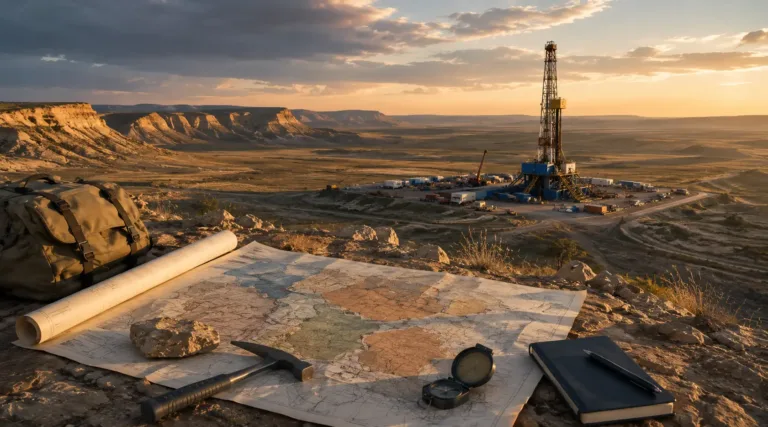
Image: AI-generated