Geologists in central Kazakhstan have discovered a deposit that could establish the country as one of the world’s key suppliers of strategic raw materials. The find — the Yuzhny Irgiz ore cluster, identified in April 2025 — holds total rare earth element (REE) resources of 20 million tonnes. If the estimates are confirmed, Kazakhstan will have built a world-class resource base for the production of magnets, electronics, and clean energy technologies.
Scientists from Tomsk Polytechnic University (TPU) and Kazakhstan’s Tsentrgeolsyomka conducted the first detailed study of the deposit’s ore. Until recently, fundamental questions remained unanswered: how the mineralisation formed, where the rare earth components originated, and how the hydrothermal fluids evolved over time. The Tomsk team combined mineralogical, geochemical, and petrological analysis to reconstruct the complete picture.
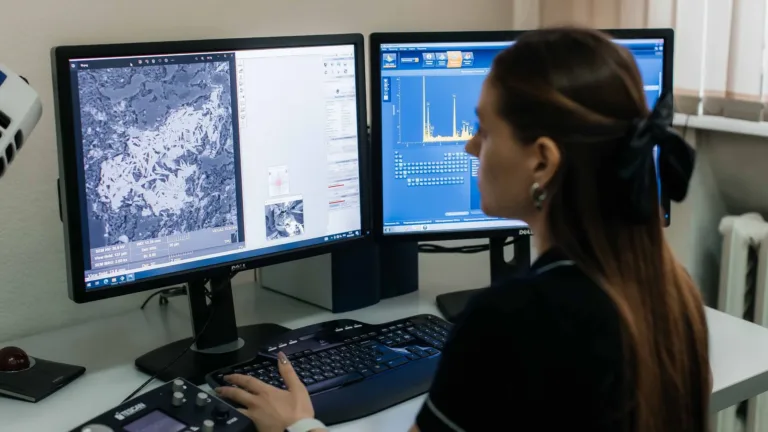
Researchers collected drill cores from depths of up to 110 metres and applied a comprehensive suite of modern techniques: optical microscopy, X-ray fluorescence, scanning electron microscopy with energy-dispersive analysis, and inductively coupled plasma mass spectrometry. This enabled them to reconstruct the evolution of the mineral system and identify the key factors controlling rare earth concentration.
The results show that the deposit belongs to the hydrothermal plutonogenic and albitite type. Potassium-sodium metasomatism played a decisive role in the redistribution and fixation of elements within the ore bodies. Geochemical zonation is clearly expressed vertically: light REEs dominate in the upper layers, while the proportion of yttrium and heavy rare earths increases with depth — a direct indicator of the gradual compositional change in the hot fluids that percolated through fractures in the host rock.
The principal REE-bearing minerals are monazite and xenotime. They formed at different stages of the hydrothermal process: magmatic monazite acted as the primary concentrator, while at later stages a portion of the elements was redeposited as xenotime and altered monazite. Niobium-titanium mineralisation (ilmenorutile and columbite) was also identified in the samples, recording successive stages of metasomatism within a single fluid system.
The Zhana-Kazakhstan ore cluster is a complex, multi-stage formation with enormous potential. The findings not only confirm the region’s promise as a source of strategic metals, but will also inform the development of future rare earth extraction technologies. For Kazakhstan, this represents an opportunity to secure a firm position on the global REE market — a space currently dominated by China.
Source: Rusmet
Image: Tomsk Polytechnic University Press Service