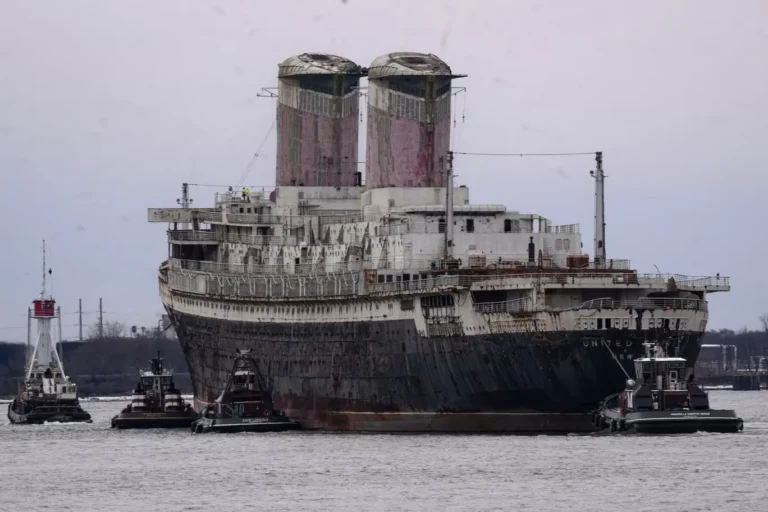
The ocean liner SS United States, which once carried world leaders and Hollywood stars across the Atlantic, is preparing for its final voyage. Okaloosa County authorities in Florida plan to sink the ship in the second week of November, about 40 kilometers southwest of Destin. On the floor of the Gulf of Mexico, the liner will become the world’s largest artificial reef.
The vessel is almost 305 meters long, more than 30 meters longer than the Titanic. The liner is regarded as a mid-century engineering achievement and was originally designed as a military transport. In 1952, it set a transatlantic speed record, covering the distance in three days, ten hours, and forty minutes at an average speed of 36 knots. That record for passenger ships has still not been broken.
For almost thirty years, the liner sat at a pier on the Delaware River in Philadelphia while advocates looked for ways to restore it. Restoration projects fell through because of high costs, and a protracted dispute over docking fees ended in a court ruling ordering the ship out of the port. In March, the vessel was towed to the Port of Mobile in Alabama, where workers spent months removing wiring, glass, plastic, and hazardous chemicals.
The project is valued at $10.1 million: the county will use these funds for purchasing, transporting, cleaning, and sinking the ship. Another $1 million is reserved for a shoreside museum dedicated to the liner’s history. Pensacola tourism authorities added $1.5 million, and the Coastal Conservation Association of Florida contributed $500,000, the largest one-time donation in its 40-year history.
The liner will settle at a depth of about 55 meters, with its upper decks about 18 meters below the surface. This will make the site accessible to both beginners and experienced divers. Nearby, 22 kilometers away, lies the aircraft carrier USS Oriskany, sunk as a dive site in 2006. Okaloosa County already has more than 500 artificial reefs, including about a dozen small sunken vessels.
Local businesses, including dive clubs, fishing fleets, and hotels, expect millions of dollars in additional revenue. Tourism industry representatives call the project a chance to put the region on the world stage and create new marine habitats.
Preserving the liner in its original form proved impossible, but sinking it gives the ship a second life. The reef will be both a tourist attraction and a home for marine organisms, a rare case in which historical heritage is turned into infrastructure for nature and the economy.
Source: The Independent
Image: AP