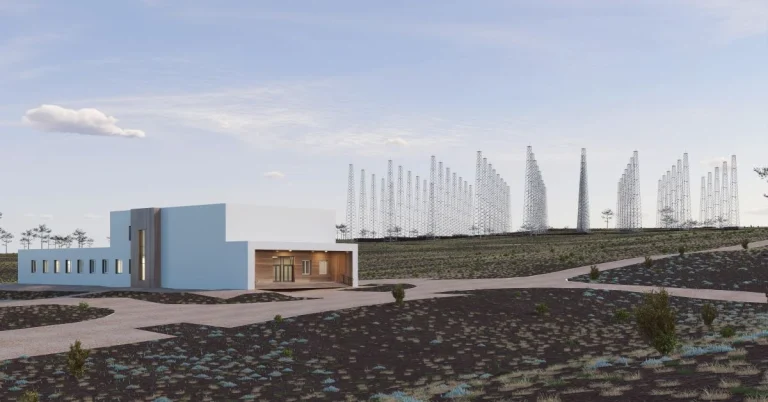
The Institute of Solar-Terrestrial Physics of the Siberian Branch of the Russian Academy of Sciences (ISTP SB RAS) received a positive conclusion from the Glavgosexpertiza of Russia for engineering surveys for the construction of a lidar and a heating stand. These objects will become part of the National Heliogeophysical Complex of the Russian Academy of Sciences and will be put into operation by 2030.
ISTP SB RAS successfully passed the stage of engineering surveys for the construction of a lidar and a heating stand, having received approval from Glavgosexpertiza. These objects will be part of the National Heliogeophysical Complex of the Russian Academy of Sciences (NGK RAS), which is being implemented with the support of the Ministry of Science and Higher Education of the Russian Federation. The scientific director of the project is Academician of the Russian Academy of Sciences Geliy Zherebtsov.
The lidar will be built on the territory of the ISTP observatory in the area of the Small Sea of Baikal, in the Kharikta area. It is designed to study the atmosphere at altitudes from 10 to 100 km. The heating stand, which will be located near Angarsk, will become part of a system for studying the ionosphere and the interaction of radio waves with the atmosphere.
According to Sergei Olemsky, first deputy director of ISTP, the lidar will make it possible to obtain data on heliogeophysical processes, such as the influence of solar activity on the atmosphere, magnetospheric changes and seismic activity.
The NGC RAS project includes several stages. The first has already been completed: optical instruments and a multi-wavelength radioheliograph have been built in Buryatia. The second stage provides for the creation of a lidar, a heating stand and a data processing center in Irkutsk.
The construction of a lidar and a heating stand is an important step in the development of heliogeophysical research in Russia. These objects will allow scientists to better study processes in the atmosphere and ionosphere, which is of great importance for science and technology.
Source: izyskateli.info