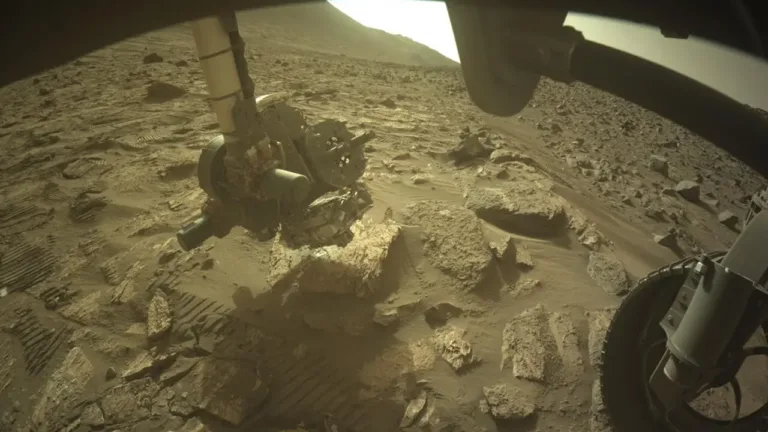
A new study has confirmed what scientists cautiously suggested last year. Complex organic carbon has been discovered in Jezero Crater, lying at a record-shallow depth—just a few microns below the Martian surface. The finding adds new momentum to one of the biggest questions in planetary science.
A research team led by Ashley Murphy of the Planetary Science Institute and Kyle Uckert reanalyzed data collected by NASA’s Perseverance rover. Their findings, published in Science Advances, show that the SHERLOC instrument mounted on the rover’s robotic arm unambiguously detected macromolecular carbon in two rock samples from the Bright Angel formation. These complex carbon networks occur on Earth in both biological and non-biological environments.
The samples were collected from a rock informally named “Cheyava Falls.” Billions of years ago, a river flowed through this area into Jezero’s ancient lake. Fine-grained sediments settled on the lakebed and eventually lithified into mudstone. It was within these thin sedimentary layers that the rover detected organic material. The carbon was found alongside carbonate and sulfate minerals that formed later through the action of water, suggesting that organic compounds entered the rock during at least two separate geological episodes.
Perhaps the most remarkable aspect of the discovery is its depth. The organic molecules were preserved just a few microns beneath the surface—thinner than a sheet of paper. On Mars, where intense solar radiation and powerful oxidizing chemicals rapidly destroy complex molecules, finding organic material so close to the surface is exceptionally rare. According to Murphy, the molecules likely survived either because they are inherently stable or because they were shielded by clay minerals and iron-rich sediments.
The researchers also emphasize another important implication. Organic compounds have now been identified in Jezero Crater, more than 3,000 kilometers from Gale Crater, where NASA’s Curiosity rover previously detected similar materials. This suggests that complex carbon compounds were far more widespread across ancient Mars than previously believed and existed in multiple lake and river environments billions of years ago.
Determining the true origin of these organic compounds will require laboratory analysis on Earth. Neither Curiosity nor Perseverance carries instruments capable of distinguishing between traces of ancient microbial life and purely geological processes. If samples from Jezero Crater are eventually returned to Earth, scientists will be able to examine them using far more sensitive analytical techniques.
For now, the origin of the molecules remains unknown. However, their preservation just beneath the Martian surface makes a Mars Sample Return mission one of the most important scientific goals in planetary exploration.
Source: phys.org
Image: NASA / JPL-Caltech