Russian researchers have made a breakthrough in the study of cosmic matter. A unique ammonium-containing mineral has been identified in the Orgayle meteorite. This discovery changes ideas about the composition of asteroids and comets.
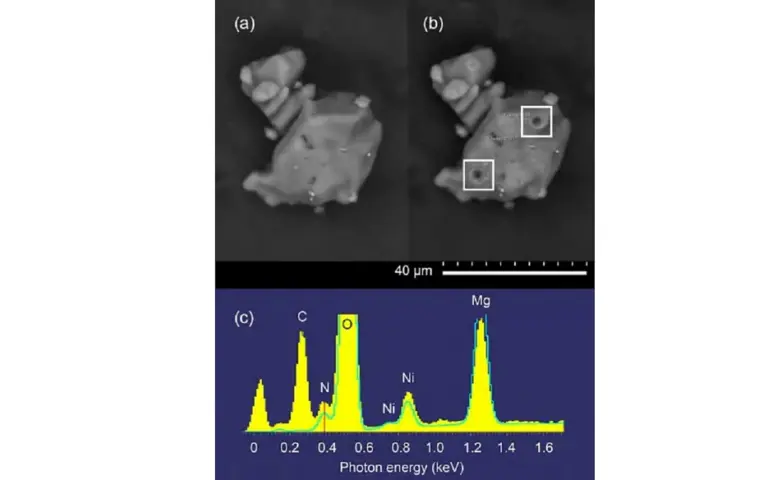
Scientists from the Vernadsky Institute of Geochemistry and Analytical Chemistry of the Russian Academy of Sciences together with colleagues from St. Petersburg university Ammonium mineral was discovered for the first time in meteorite matter. The object of the study was the primitive carbonaceous chondrite Orgueil, which is similar in composition to the asteroids Ryugu and Bennu.
The exposed mineral, nickel bussengotite, is a hydrous sulfate metal and ammonium. The researchers studied it using modern analytical methods, including microprobe and single-crystal X-ray diffraction analysis. The results showed that this mineral is different from previously suspected volatile organic compounds or ammonia phyllosilicates.
As Marina Ivanova, Doctor of Geological and Mineralogical Sciences, explained, new approaches to the study of extraterrestrial matter help overcome existing problems in this area. This is especially important when studying samples delivered by spacecraft, where the possibility of technogenic contamination cannot be ruled out.
Until now, the problem of identifying ammonium carriers in space has remained in science. Natural sulfates, which include bussingottite, can serve as such carriers in the conditions of cometary nuclei and carbonaceous asteroids.
The discovery of the first ammonium mineral in a meteorite may require a rethink of analytical methods applied to extraterrestrial objects. These minerals are rare and unstable, which explains their late discovery. The research was carried out with the support of the Russian Ministry of Education and Science and opens up new opportunities for studying the evolution of the Solar system.
The material was prepared with the support of the Russian Ministry of Education and Science as part of the Decade of Science and Technology.
Source: minobrnauki.gov.ru