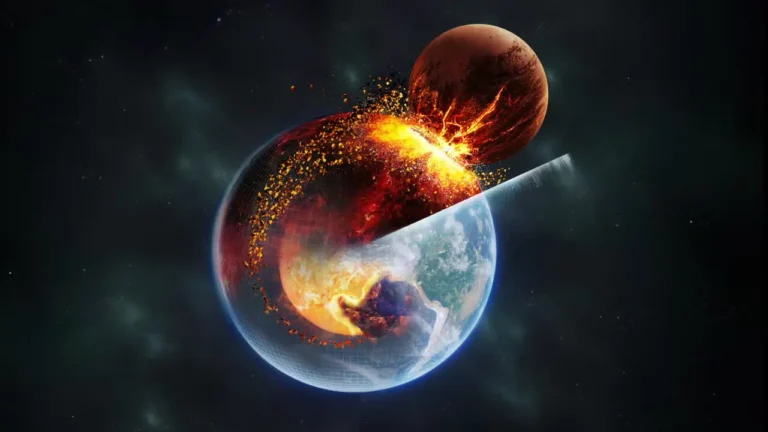
Two gigantic continent-sized structures hidden deep inside Earth may be fragments of Theia, the planetary body that scientists believe collided with the young Earth about 4.5 billion years ago, producing the debris that eventually formed the Moon. Geophysicists now have a possible explanation for where the second body involved in that cosmic collision went.
The mysterious structures, known as large low-shear-velocity provinces (LLSVPs), lie at the boundary between Earth’s mantle and core beneath Africa and the Pacific Ocean. Each is roughly twice the size of the Moon. Seismic waves slow down as they pass through these regions, indicating that the material is unusually dense and has a distinct composition.
A study published in Nature by researchers at the California Institute of Technology (Caltech) proposes that these structures could contain preserved fragments of Theia’s mantle. The giant-impact hypothesis has long provided an explanation for key characteristics of the Earth–Moon system, but scientists have struggled to find direct evidence of the impactor itself.
Geophysicist Qian Yuan, one of the researchers behind the idea, said the hypothesis emerged during a scientific seminar. When a discussion raised the question of what happened to the impactor after the collision, he began comparing the iron-rich composition expected in Theia with the unusually dense regions deep within Earth’s mantle.
Computer simulations showed that the collision would not necessarily have melted the entire mantle. The upper part could have become molten while deeper material remained relatively cool and solid. This would have allowed fragments of Theia’s mantle, estimated to have been 2–3.5% denser than Earth’s surrounding material, to sink toward the core without fully mixing into the planet’s mantle. The resulting blobs, about 50 kilometers across, could have solidified within roughly 1,000 years.
Long-term simulations reproduced the process: dense material gradually sank and, over billions of years, accumulated into two isolated thermochemical piles remarkably similar to the structures observed near Earth’s core. Their calculated mass and share of the mantle’s volume were also broadly consistent with measurements of the real LLSVPs.
Volcanic rocks could provide a way to test the hypothesis. Some ocean-island basalts contain noble gases that predate the collision with Theia. If these chemical signatures match those found in lunar samples, researchers could establish a much stronger link between Earth’s deep interior, Theia, and the Moon’s formation.
If the hypothesis is confirmed, an essentially untouched fragment of an ancient planetary body could have been preserved deep inside Earth for 4.5 billion years. That would reshape our understanding not only of the Moon’s origin, but also of how planets survive giant impacts and develop their internal structures.
Source: Nature
Image: Deng Hongping and Hangzhou Sphere Studio