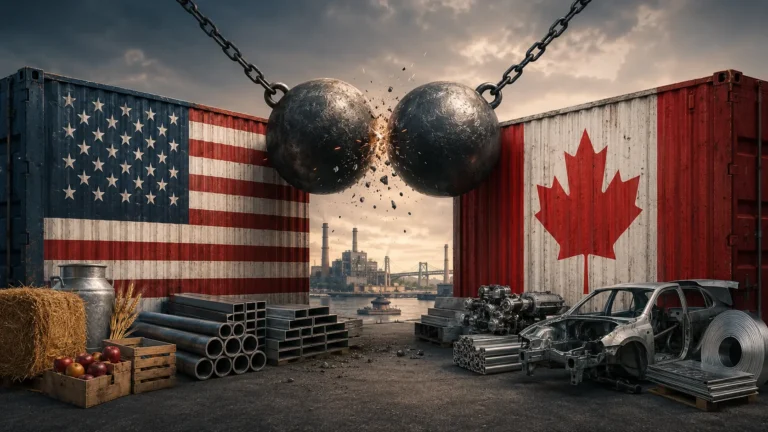
Washington and Ottawa have once again crossed swords over trade. The United States has imposed tariffs of up to 50% on nearly $20 billion worth of Canadian goods, while Canada is preparing a matching response covering around 700 products. The deeper problem is that the two economies are so tightly integrated that every blow against a neighbor can also hit the attacker’s own factories.
After the latest round of trade talks collapsed, the U.S. imposed tariffs on a broad range of Canadian goods, from agricultural products to hockey sticks. The measures affect approximately 5% of Canada’s exports to the United States.
Ottawa responded in familiar fashion. Its “dollar-for-dollar” retaliatory tariffs are scheduled to take effect on September 8, with rates of 15%, 25%, and 50%. The list includes more than 700 products, among them steel, aluminum, electronics, and metal goods.
President Donald Trump has also threatened to raise tariffs to 50% from January 1, 2027, on Canadian cars, trucks, auto parts, and metal products. Canadian officials have openly accused Washington of seeking to cripple Canada’s industrial base and move manufacturing south of the border. The premier of Ontario has already warned that, if the conflict escalates, the province could restrict exports of electricity and critical minerals to the United States.
The paradox is that the two countries have spent decades building a single integrated industrial ecosystem. Their supply chains in automobiles, energy, and manufacturing are so interconnected that the border has become little more than a formality. An individual component can cross the border several times before becoming part of a finished vehicle. As a result, a prolonged trade war would not simply hurt some abstract “other side”—it would hit specific factories, jobs, and consumer prices in both countries.
The real question is no longer which country can impose higher tariffs, but which one will realize first that it is damaging its own productive capacity. In such a trade war, there will be no real winners—only survivors.
Source: @CarierNews