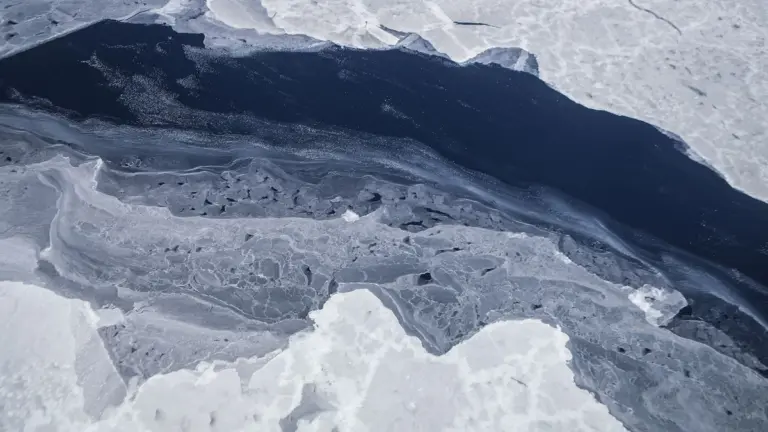
Studies of marine sediments have shown that in the past ice sheet West Antarctica has repeatedly retreated sharply into the interior of the continent. This confirms the high risk of accelerated melting and sea level rise in the future.
The Thwaites and Pine Island glaciers in West Antarctica are now considered among the fastest melting on the planet. They are losing ice at a faster rate than other areas of the continent, heightening concerns about the safety of the entire West Antarctic Ice Sheet.
To understand how the region is responding to warming, an international team of scientists looked to history. Researchers studied marine sediments recovered from the Amundsen Sea during the IODP expedition. These layers of sediment preserve information about the state of glaciers and the ocean over millions of years.
The analysis showed that during the Pliocene era, from 5.3 to 2.6 million years ago, when the temperature on Earth was 3-4 degrees higher than today, the edge of the ice sheet went far inland at least five times. In those periods, the level of the world’s oceans was more than 15 meters higher than today, and a significant part of this rise was associated with Antarctica.
Scientists have discovered characteristic layers in the sediments saturated with debris breedsbrought by icebergs. These fragments provide a direct indication of large-scale melting. Based on their chemical composition, it was possible to establish that the ice was retreating all the way to the interior of West Antarctica, including the mountain ranges in the center of the continent.
The study also made it possible to reconstruct a repeating cycle: during cold periods, the ice sheet expanded and was relatively stable, but during warming it began to rapidly lose mass, large icebergs broke off, and the ice retreated hundreds of kilometers. Then, as temperatures dropped, an equally rapid recovery occurred.
The authors of the work emphasize that the ice sheet did not disappear completely in the past, but its retreats were sharp and significant. This means that even moderate and prolonged warming can trigger large-scale changes.
Source: Phys.org
Photo: Mario Tama