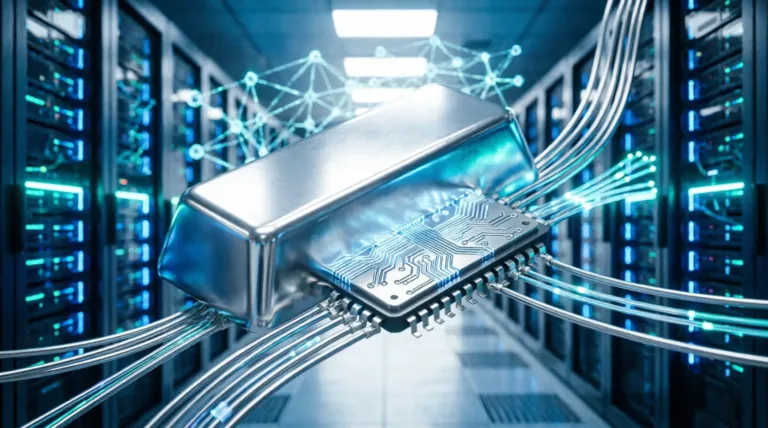
Artificial intelligence has quietly turned silver into one of the most strategic metals of the digital age. While discussions often focus on copper and lithium, silver’s unmatched electrical conductivity is making it an essential building block for the thousands of new AI data centers being constructed around the world.
The scale of the transformation is remarkable. Over the past 25 years, global data center capacity has expanded from less than 1 gigawatt to approximately 50 gigawatts—an increase of more than 5,300%. The growth trajectory continues to accelerate as AI adoption drives demand for ever-greater computing power.
Silver is the most electrically conductive metal known, making it indispensable wherever speed, efficiency, and reliability are critical. It is used in busbars and switchgear, uninterruptible power supply (UPS) systems, high-speed server cables and connectors, as well as in the packaging of graphics processing units (GPUs), tensor processors, and memory chips—the core components of modern AI infrastructure.
According to industry data, the United States imports 64% of the silver-based connectors and components used in data center construction. This dependence on foreign suppliers increases the vulnerability of digital infrastructure to disruptions in global supply chains.
Figures from The Silver Institute reinforce the trend. Global silver demand exceeded 1.2 billion ounces in 2025, with industrial consumption remaining close to record highs. The electronics sector, together with the rapidly expanding AI industry, has become the primary driver of this growth.
The AI boom is reshaping commodity markets. Silver is evolving from a metal primarily associated with jewelry and investment bullion into a critical industrial material powering the digital economy. As more AI data centers are built, the strategic importance of this highly conductive metal will only continue to grow.
Source: The Silver Institute