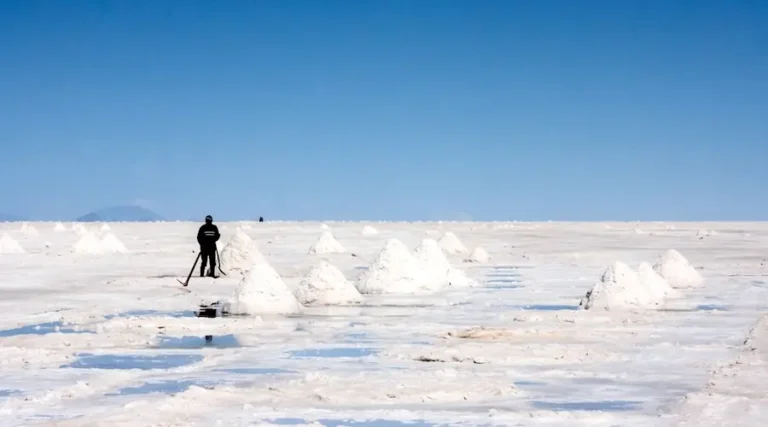
South America’s lithium triangle, which spans Argentina, Bolivia, and Chile, holds about 43% of the world’s identified lithium resources. However, differing brine compositions and limited access to water stand in the way of turning this wealth into actual supply. Geologist José Cabello has published a review examining the potential and obstacles for the region’s 43 salt flats.
According to 2026 estimates from the US Geological Survey, the three countries together have 64 million tonnes of identified lithium resources, against a global total of about 150 million tonnes. Argentina accounts for 28 million, Bolivia for 23 million, and Chile for 13 million.
Cabello notes that his review confirms the high quality and volume of resources in the central Andean salt flats. His compilation accounts for more than 16 million tonnes in Argentina and Chile. These figures describe contained lithium, not the lithium carbonate equivalent that often appears in project presentations. Resources also differ from reserves, the portion that can be extracted profitably.
The distinction is critical for a region where deposits vary widely in concentration, impurities, and groundwater behavior. A large lithium volume alone does not say how much can be produced, at what cost, and with what environmental consequences.
The lithium brines of the central Andes formed over thousands of years under the influence of volcanic rocks, tectonics, and an arid climate. Weathering releases the metal from rocks, water carries it into closed basins, and evaporation concentrates it together with potassium, boron, and magnesium.
Unlike hard-rock deposits, these resources sit within a mobile groundwater system. This creates particular difficulties for exploration, sampling, and estimating recoverable reserves.
The Chilean example. Salar de Atacama has become the leading source of brine lithium thanks to a drier climate, fewer impurities, and convenient export routes compared with neighboring sites. According to USGS, in 2025 Argentina and Chile together produced about 79,000 tonnes of lithium, roughly 27% of global output.
Cabello singled out Altoandinos and Pedernales in Chile, and Hombre Muerto Oeste, Rincón, Sal de los Ángeles, and Sal de Vida in Argentina as especially promising sites. About ten operations are currently running in the region, with several more projects in development.
Technology and water. Developing new deposits requires understanding how brine pumping will affect groundwater and ecosystems. In arid areas, freshwater availability adds another constraint. Direct lithium extraction (DLE) technology could help develop sites poorly suited to conventional evaporation ponds, by shortening processing times and using less water.
However, as Cabello stresses, brine withdrawal must be distinguished from freshwater consumption. Different technologies balance these parameters differently: some pump less brine but use more freshwater, others the reverse. The choice of method therefore depends not only on extraction efficiency but also on local conditions.
The lithium triangle remains the planet’s largest lithium reserve, but its development hinges on hydrology, ecology, and economics. Cabello’s review shows that further work should focus on detailed study of individual salt flats and on assessing the less certain resource categories.
Source: MINING.COM
Image: Sharon Jones