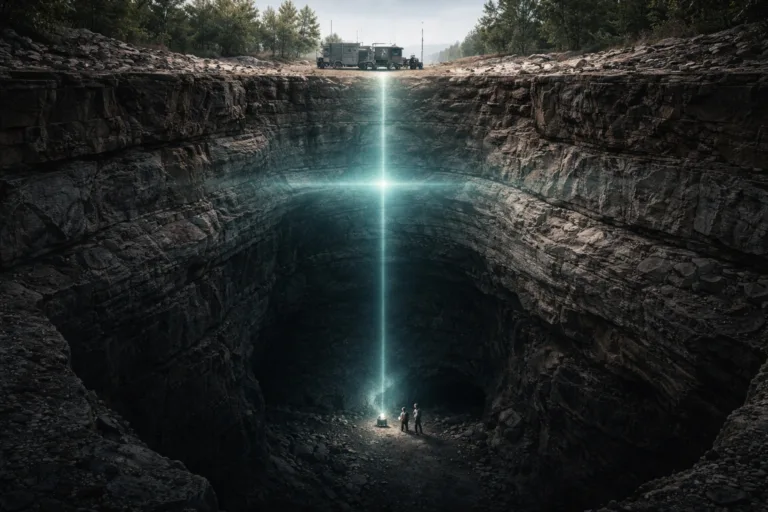
Researchers from the Electronics and Telecommunications Technology Institute (ETRI) have achieved the world’s first stable two-way wireless communication at a depth of 100 meters. The secret is in the use of magnetic induction, which, unlike conventional radio waves, does not die out in the thickness of the soil.
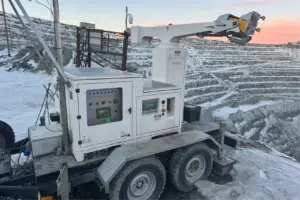
Engineers refused from traditional high-frequency signals, which are quickly attenuated in rocks. Instead, they created a system operating at a frequency of about 15 kilohertz. A transmitting antenna with a diameter of one meter generates a low-frequency magnetic field. It freely penetrates through masses of limestone, and a compact receiver measuring only a few centimeters confidently picks up the signal. The transmission speed reaches 2-4 kilobits per second – enough for transmitting text messages and telemetry data.
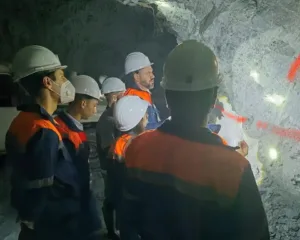
Testing took place in real conditions of a limestone quarry. A connection was established between the surface and the fifth underground horizon. The distance in a straight line is exactly 100 meters. This result is officially recognized as a world record.
The development is designed to solve a problem that has remained the “Achilles heel” of mining and rescue work for many years. At mine collapse or accidents on underground communications, communication with people trapped is often completely lost. The new technology allows you to quickly organize a channel for exchanging information, without waiting for rescuers to break through the rubble with the cable.
In addition to saving people, the system can be used to monitor the condition of gas pipelines, oil pipelines and reservoirs that run underground. Instead of laying wires to each sensor, it will be enough to install compact receivers that operate from a magnetic field.
ETRI’s development transforms underground space from a zone of radio silence into a controlled environment, which means safety in mines and critical underground facilities reaches a fundamentally new level.
Source: @cdutek