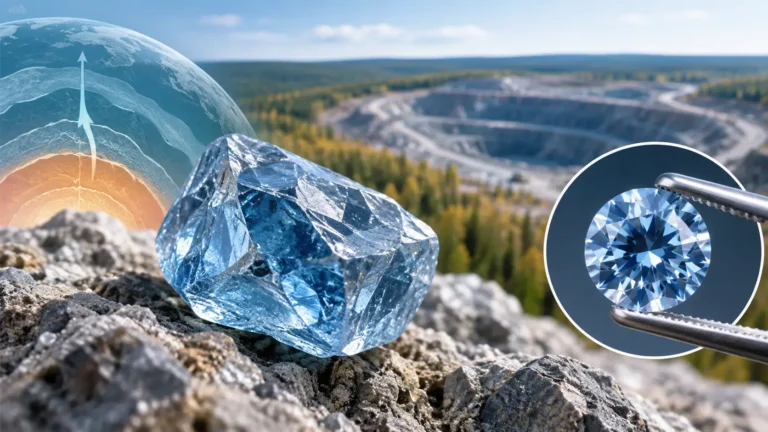
ALROSA has recovered a 2.74-carat diamond at the Nakyn kimberlite field, the first natural gem-quality blue stone in the history of Russian deposits. Specialists are now completing the cutting, and the finished diamond is planned to be shown in late November. However, the value of the find goes far beyond the jewelry market.
Blue diamonds belong to type IIb, and their color is linked to a trace amount of boron. The concentration of the element is extremely small, on the order of 0.01–10 ppm, meaning that for every million carbon atoms in the lattice there are no more than ten boron atoms. It is boron that absorbs yellow light and gives the stone its blue hue. In nature, such diamonds are incomparably rarer than pink ones: their share of global production is estimated at roughly 0.1%, and annual output is measured in dozens of stones.
The geological history makes the find even more remarkable. It is believed that the boron needed for the coloring enters the depths of the mantle with oceanic crust through subduction zones. Blue diamonds form at depths estimated at hundreds of kilometers, significantly deeper than ordinary diamond-bearing horizons. For the Nakyn field, this is the first confirmed case of boron-bearing diamonds, and it opens a new page in the study of Yakutia’s geology.
How highly such stones are valued is shown by auction history. In 2016, the 14.62-carat “Oppenheimer Blue” went under the hammer for almost $58 million, and the per-carat price record is held by the “Blue Moon of Josephine,” at about $4 million per carat. Of course, 2.74 carats is a different scale, but the very fact that a stone of this type has appeared in Russia matters for the country’s reputation in the market for rare colored diamonds.
Eleven ALROSA specialists are working on the cutting. The task is to reveal the color and preserve the clarity, since, according to the company, the stone has no inclusions. CEO Pavel Marinychev noted that such a find may never be repeated.
The blue crystal from the Nakyn field is both a jewelry sensation and scientific evidence of deep processes that took place in the Earth’s interior. What kind of diamond it will become will be clear in late November, but its status as the first of its kind is already secured.
Source: ALROSA