Global coal production remains at record levels, even despite the transition to green energy. According to the International Energy Agency (IEA), in 2025, coal demand grew symbolically – by 0.5% to 8.85 billion tons, while production in 2024 reached a maximum of 9.15 billion tons. It would seem that the era of coal is passing away – Europe is closing mines, the US is reducing generation – but the figures say otherwise.
Who are the leading countries in coal production today, how countries are distributed in terms of coal production and reserves, and what will shape the global market in 2025 – let’s look at the IEA data(Coal 2025 and Coal Mid-Year Update 2025) and Statistical Review of World Energy 2025 from the Energy Institute.
Top 6 countries by coal production in 2024-2025
The main coal producing countries are in Asia. In 2024, China, India and Indonesia produced more than 6.6 billion tons – about 72% of global production. In 2025, the top three remain in the top three, but Indonesia is reducing production for the first time since the pandemic due to falling demand from China, which has become saturated with incoming resources.
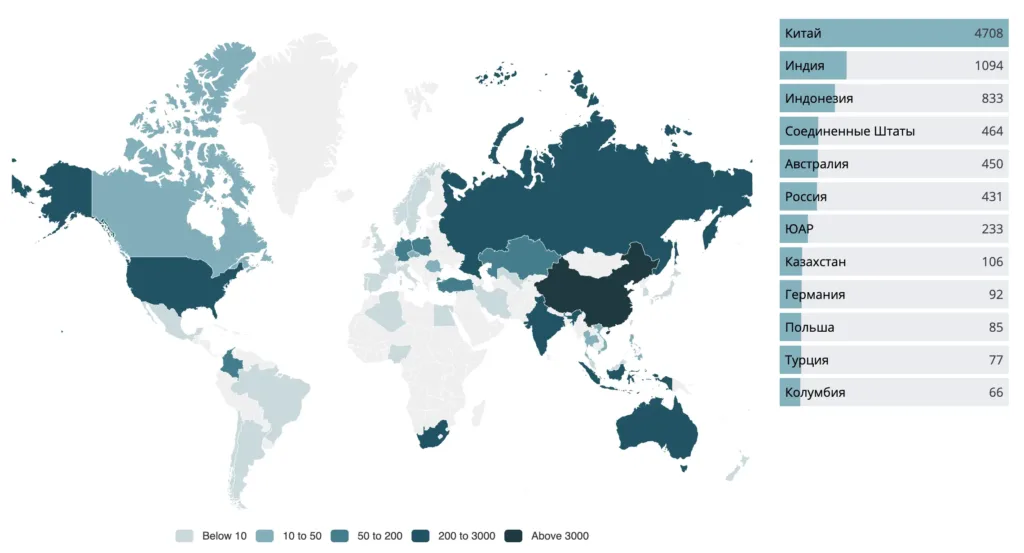
China is the world leader in coal among all countries
The main coal regions are Inner Mongolia, Shanxi and Shaanxi provinces, where the largest deposits and mining centers are concentrated: Shenfu-Dunsheng, Ordos and Datong basins.
China is one of the most coal-rich countries, but that’s not even the main thing. China consumes the most raw materials in the world – about 56-58% of global demand falls on it. Every second ton of hard coal mined on the planet is burned in China. The bulk of the raw material is supplied to the power industry. About 60% of electricity in the country is produced at coal-fired thermal power plants. Another 20-25% of consumption is accounted for by metallurgy and about 10% by the chemical industry.
Despite producing huge volumes, China remains the largest importer. In 2024, purchases will reach 548 million tons. The reason is simple: it is cheaper to transport coal from a coastal port to the eastern provinces than to bring it from the mines of Inner Mongolia. The main suppliers are Indonesia, Australia, Russia and Mongolia.
India and Indonesia – production growth and different market models
India ranks second among the leading countries in coal production. In 2024, production exceeded 1 billion tons, increasing by about 7% per year. The main coal producing regions are in the east and center of the country: the Raniganj and Jharia coal basins, Talcher and Ib Valley.
Indonesia, on the other hand, is export-oriented. In 2024, production reached 836 million tons, of which more than 560 million tons were supplied to the foreign market. Indonesia’s key regions and deposits are the coal basins of Kalimantan (Borneo) and Sumatra Island.
The difference between the two countries is fundamental. India mines for itself and increases production to meet domestic demand. Indonesia is one of the leading coal-exporting countries, and its production depends directly on how much buyers are waiting. So the slowdown in Chinese imports in 2025 due to falling domestic prices has hit Indonesia hard.
Without geology there is no technological future: who and how will provide the world with metals? – read how the mining industry is becoming the foundation for a new economy
Leading countries by coal reserves: who has the most resources in the ground
According to the Energy Institute, the largest deposits are concentrated in five countries: USA – 23-25%, Russia – 15%, Australia – 14%, China – 13%, India – 10%. In total, they account for about 75% of all explored coal resources.
This shows a key feature of the market: the leading countries in terms of reserves and the leading countries in terms of production are not always the same. For example, the US has the largest resources but is behind China and India in terms of production, while China, with smaller reserves, remains on the list of producing regions due to high domestic demand.
Russia: huge reserves, but restrictions on production
Russia ranks second in the world in terms of coal reserves – about 162 billion tons. The main deposits are concentrated in the Kuzbass, Kansk-Achinsk and South Yakutia coal basins.
At the same time, Russia is only at the end of the top six leading countries in coal production. In 2024, the volume was about 427 million tons according to Rosstat (or 443.5 million tons according to the Russian Ministry of Energy).
The gap between reserves and production is explained by geography. A significant part of the fields are remote from ports, and exports are by railroad. The throughput capacity of the BAM and Trans-Siberian Railway does not allow for a rapid increase in supplies. Coal terminals in the east of the country are only 57% loaded.
Arctic. There are reserves – no economy – read why colossal resources are not turning into production and what is behind the gap.
Coal exporting countries: who trades on the world market
Only a part of the extracted coal – about 18% – is supplied to the external market. The main volume is used within countries, primarily in China and India.
The largest coal exporting countries in 2024:
- Indonesia – more than 560 million tons;
- Australia – about 370-390 million tons;
- Russia – about 196-199 million tons.
The geography of exports is clearly shifted towards Asia. According to the IEA, about 85% of international deliveries fall on the Asia-Pacific region, where the largest importers – China, India, Japan and South Korea – are concentrated.

The structure of exports differs. Indonesia supplies mainly thermal coal for power plants, Australia supplies coking coal for metallurgy (particularly for steel production), and Russia combines both.
The energy transition requires metals, and that’s putting new pressure on the mining industry. Read more: Net Zero without illusions. Why green energy is being held back by metal scarcity
Global coal market in 2025-2030: on the verge of a turning point
The IEA estimates that by 2030, global demand for coal will decline by about 3%, but will not collapse. The main reason for the slowdown is the growth of solar and wind generation in China, which leads the world in terms of commissioned renewable energy capacity. At the same time, India is moving in the opposite direction. The IEA expects both coal production and consumption to grow in the country through 2030. This makes it the only major exception among all producers.
Coal is not going away – it is being redistributed. And how quickly China and India introduce renewable capacity is now more important to the market than any climate solutions from Europe. For those who work in the mining industry or analyze commodity markets, it is this shift that is the main parameter to track over the next five years.
Cover photo taken from the official website of Mechel PAO