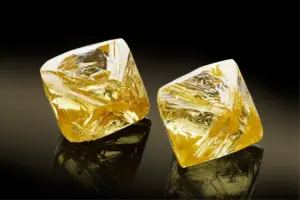
When you imagine diamond mining, what comes to mind is a quarry, dump trucks the size of houses, and explosions. Everything is true, but this is just the general picture. It’s not enough to get ore out of the ground; the diamond still needs to be separated from tons of waste rock without being split. Let’s look step by step at what methods diamonds are mined and why their choice is almost independent of the engineer.
First, about the shape of the deposit
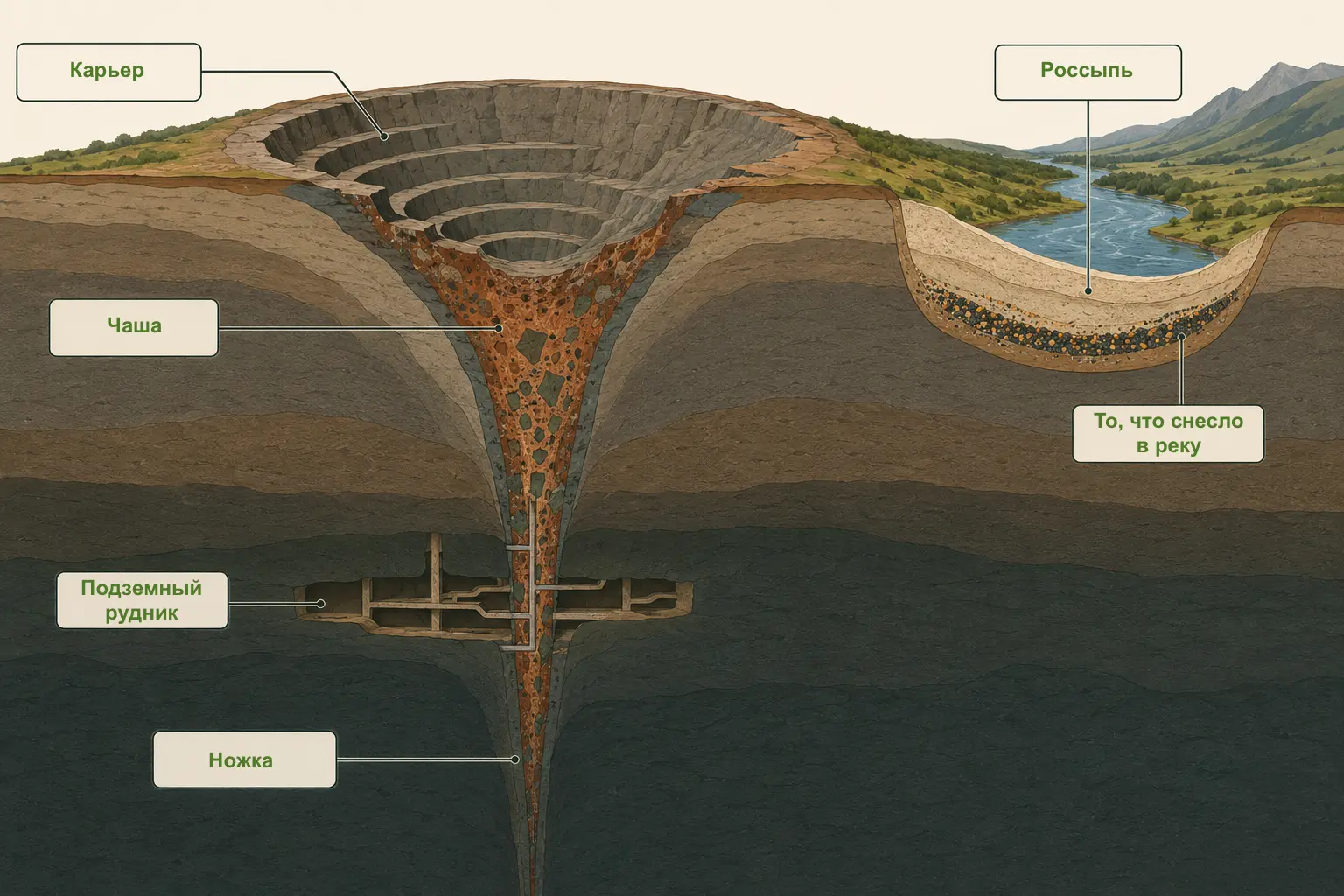
Most diamonds rises to the surface through kimberlite pipes. They can be compared to bowls on a long stem: on top, near the surface, there is the wide part of the vessel, on the bottom there is a leg that tapers meter by meter. This geometry influences how the stone is quarried:
- while the ore is in the upper part, it is selected in the quarry;
- when the tube narrows and goes deeper, an underground mine is built;
- what nature has eroded over millions of years and carried into rivers is extracted from placers.
Open pit diamond mining
The most common method of diamond mining is open-pit mining. The logic is simple: the upper part of the tube is wide and lies close to the surface, making it the cheapest to develop.
First, waste rock (overburden) is removed, then the ore is crushed by drilling and blasting – one industrial explosion brings down tens of thousands of tons. Excavators load crushed kimberlite into dump trucks, which transport it to the processing plant. As a result, the quarry goes down like a giant funnel with a spiral ramp.
U diamond mining open method there is a limit. The deeper the face, the more waste rock has to be removed to produce a ton of ore, and the more difficult it is to keep the sides from sliding. At some point, digging down becomes more expensive than going underground.
Underground diamond mining
When the quarry is exhausted, a mine is built under the pipe. The narrow “leg” is usually mined using a block caving system: the ore is cut from below, it falls under its own weight, it is collected at the lower horizon and lifted upward. It sounds simple, but in Yakutia diamond miners has its own northern enemy.
The main difficulty is water and underground brines in the permafrost. How serious this is was shown by the accident at the Mir mine in August 2017, when 151 people disappeared in a flooded mine. According to the findings of Rostechnadzor, the reason was a combination of hydrogeological, technical and organizational miscalculations. The old quarry was mothballed “dry”, salt was stored directly on its side, which is why the water transfer adits failed ahead of schedule. The project did not provide for monitoring the influx of brines at all.
Read also where kimberlite pipes are found and why the country’s leadership is in question: “Diamond mining areas: where in Russia they are looking for new deposits»
Mining diamonds using the placer method
The scattering is a gift from nature that has worked for a person. Diamond is hard and dense, so when the pipe eroded, rivers carried the stones into the valleys. There is no need to blow up anything here: diamond-bearing sands are washed with water and separated by density using jigging machines and dredges. Heavy diamond is sifted from light sand and gravel.
There is a common misconception that placer mining is only done in the summer. In fact, only the washing of sand depends on heat. You can spill them with water until it freezes. The enterprise itself does not stand idle in winter. For example, the Almazov Anabara mines in Yakutia operate all year round and around the clock.
Don’t think that the scattering brings only small change. Stones from there are no worse than “pipe” ones. At the Ebelyakh field during the night shift from the sands got it clear crystal weighing 262.5 carats.
A recent example from the life of the industry – ALROSA stops diamond mining in Yakutia
What happens after slaughter
And now – the most interesting part. The stone must be removed from the rock intact. This can be done in different ways, and it depends on how the enrichment chain is set up how many crystals will survive and how many will crumble or go to waste.
| stage | What property of diamond does it work on? | Weak point |
| Crushing | a diamond is harder than rock – it is crushed, and he is freed | Rough crushing kills the largest stones |
| Heavy medium separation | diamond is heavier than most minerals – sinks in a heavy environment | other heavy minerals settle along with the stone |
| X-ray luminescence separation (RLS) | Under X-ray, the diamond glows – the sensor catches the flash, a stream of air dislodges the stone | does not see colorless type IIa stones |
| Finishing: pneumatic flotation (RF) / fat tables (world) | diamond is hydrophobic – sticks to a bubble or fat | collects mostly small change, labor-intensive |
The ore is crushed not in one pass, but gradually, ever finer, so as not to split the crystals. According to industry researchers, during grinding, the most expensive diamonds – from 10 carats and above – are partially destroyed, so in Russia they are developing the method of fast tagged neutrons. It allows you to see a large stone in a piece of rock even before the crusher.
A separate headache is the x-ray luminescence separation on which the extraction rests. Director of Aikhal Mining and Processing Plant ALROSA Evgeny Denisov explains, that uniquely pure type IIa diamonds contain almost no nitrogen and therefore hardly glow, which means that conventional separators will miss them. This is solved by new generation separators. In 2025, ALROSA engineers demonstrated an installation that combines X-ray luminescence and X-ray analysis.
Read on topic:
— ALROSA modernizes production in Mirny
— Large diamonds of the Arkhangelsk region
The method of mining diamonds is dictated by the pipe itself. Quarry, mine and placer are the only options to get to the ore. There is painstaking work ahead – to separate the stone from the rock and not lose it. Perhaps this is why the most expensive tool is not an excavator, but a separator.
What do you think is the most capricious link in diamond mining? Tell us in the comments.
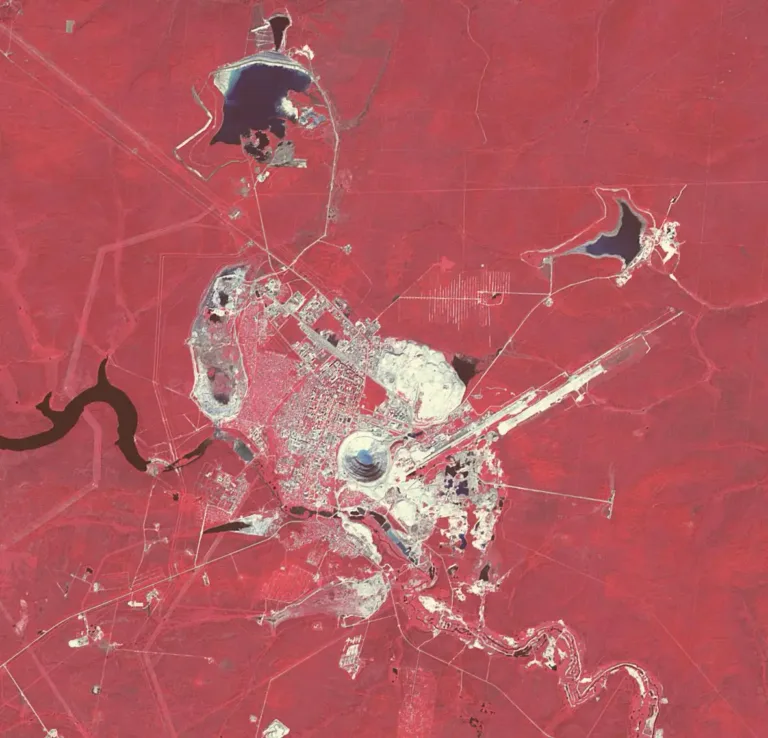
The cover photo was taken from the official NASA website. The Mir mine photographed by the ASTER spacecraft