How coal is mined—with the help of explosives and excavators, miles of underground conveyors, or powerful water jets that destroy the seam right at the face—depends primarily on the depth of the deposit and how much waste rock needs to be removed to obtain tons of raw materials.
According to the Central Dispatch Department of the Fuel and Energy Complex, at the beginning of 2024, there were 52 mines and 127 open-pit mines operating in Russia, and each enterprise has its own coal mining technology. We are analyzing the production chain based on research from the Institute of Coal of the Federal Research Center UUKh SB RAS, because the choice of method at the start determines the cost for years to come.
Where and how coal is mined: the main deposits of Russia
According to proven reserves, Russia – third in the world: 146 deposits, 273 billion tons of raw materials. But production is concentrated not where coal is simply available, but where it is easier to get. The open method consistently costs 20–25% cheaper than mine. True, logistics are added to the price of production. For example, for Kuzbass, delivering coal to the Far East by rail in 2024 was more expensive than mining itself.
Kemerovo region
According to Rosstat, in 2025 Russia raised from the subsoil 429 million tons of coal – slightly more than in 2024. Half of this volume was given Kuzbass. In 2025, Kemerovo region got it 190.7 million tons – 3.9% less than a year earlier.
Kuzbass is rich in both coking coal for metallurgy and energy production, so there are both mines and open pit mines. Mined Hard coal in this region is underground at a depth of up to 900 meters, and brown and thermal coal is found in open-pit mines. The country’s largest coal companies operate here: SUEK, Kuzbassrazrezugol, Raspadskaya.
Krasnoyarsk region
According to proven reserves first in the country — Kansk-Achinsk basin: 79 billion tons, or 43% of all balance reserves. Brown coal is mined in this basin exclusively by open-pit mining, since the layers lie close to the surface, their thickness reaches 100 meters. It is unprofitable to transport raw materials far, so low-calorie brown coal is burned directly at local thermal power plants. The flagship of the basin is the Borodino open-pit mine of SUEK.
Coal is not the only mineral hidden in the depths of Siberia. Rare metals lie near coal basins, without which not a single modern battery or turbine can operate. Read, why the Arctic is becoming a new hotspot for the mining industry
Republic of Sakha
In the east of the country quickly dials weight South Yakutsk basin. In 2025, Yakutia produced more than 51,6 million tons – volumes have tripled in seven years. The coal here is coking and is in demand in Asia, but the mining conditions are difficult: permafrost, remoteness from ports. The Pacific Railroad, which opened in 2025, changed the situation. Raw materials from the Elginskoye field received direct access to the Sea of Okhotsk.
Stages of coal mining: from exploration to transportation
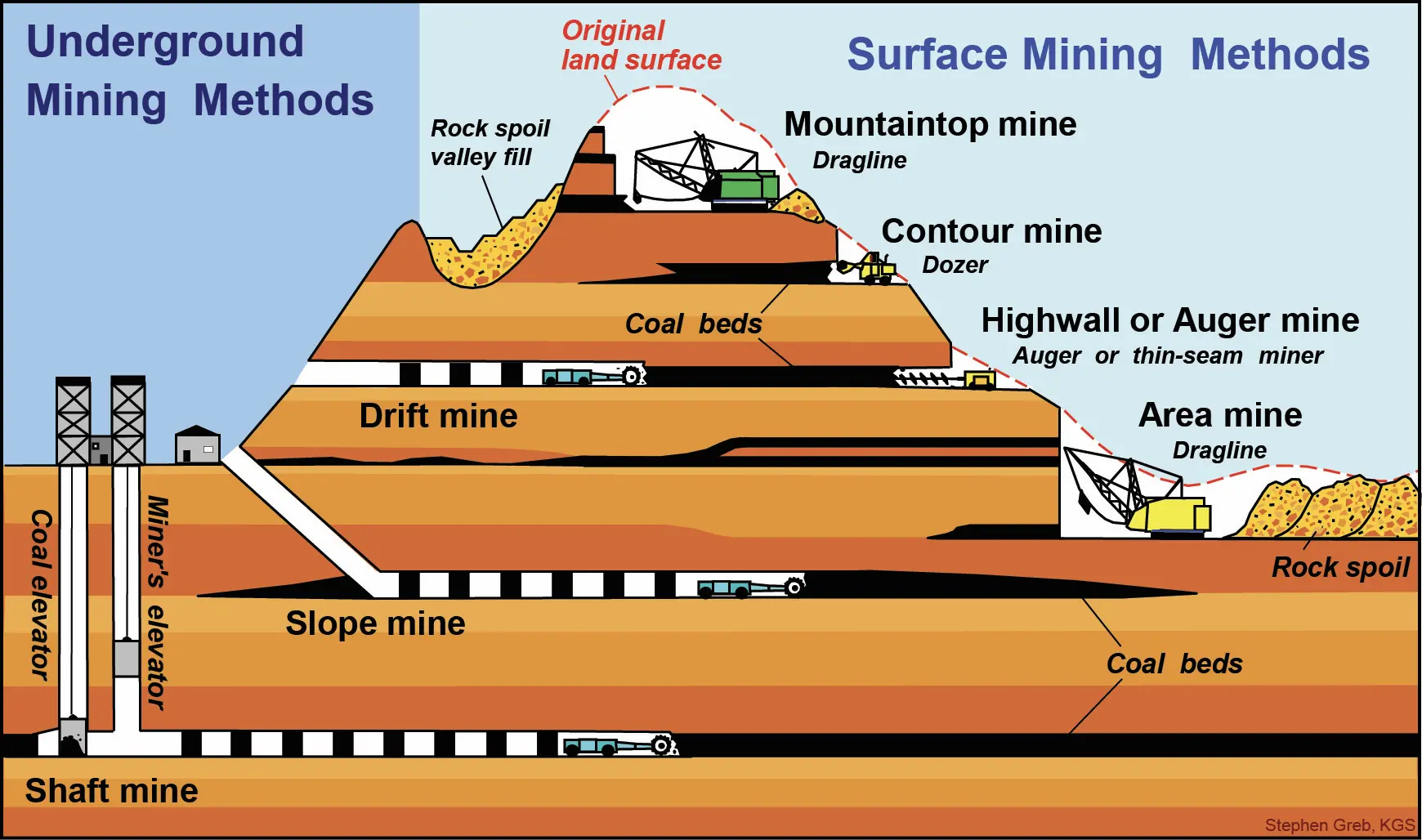
Coal mining is chain of five stages. Each is either enshrined in law or directly determines the safety and cost of production.
- Geological exploration. First you need to prove that there is coal and it profitable to mine. Exploration determines reserves, quality of raw materials – ash content, calorific value, sulfur content – and mining and geological conditions: depth, thickness of layers, water cut. Without this, a development license will not be issued.
- Field preparation. In the context remove Overburden rocks are excavated and blasted, then removed to dumps. Vertical or inclined shafts are created in the mine and underground workings are laid: drifts, slopes, walkways. It takes years to build a mine, all down to the first kilogram of coal.
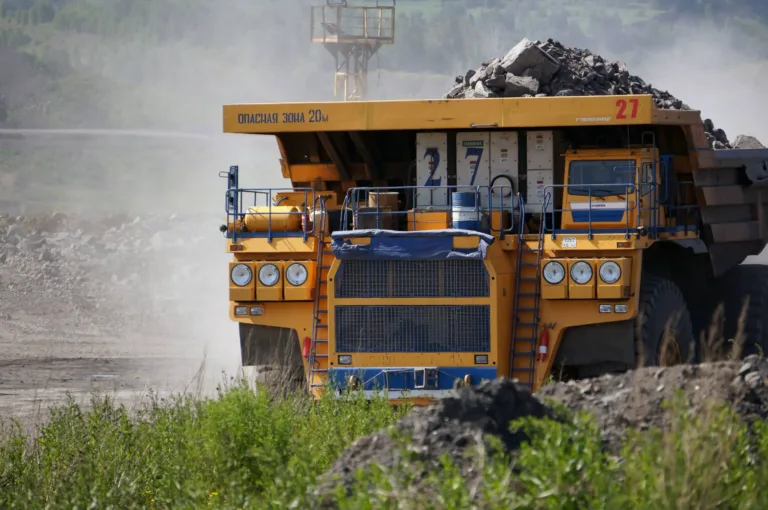
- Cleaning work – coal mining. An excavator removes the coal seam, and dump trucks transport it to a warehouse or consumer. In the mine, the main method is the longwall: a shearer cuts the coal, it falls onto a conveyor, powered support holds the roof and moves behind it.
- Coal transportation. In the mine, coal travels along a conveyor to the shaft and is lifted to the surface in skips. From the mine – by dump trucks to the railway. Next – to the processing plant or to the consumer.
- Reclamation. Cut fall asleep overburden, apply a fertile layer, and allow the soil to sit for two years. In practice, this stage is often delayed, although it is required by law.
The exact method in which raw materials are removed depends on what lies in the seam: hard coal or brown coal.
If you are interested in how the extraction of other minerals works and why not a single technological chain works without geology – read our material
Coal processing technologies
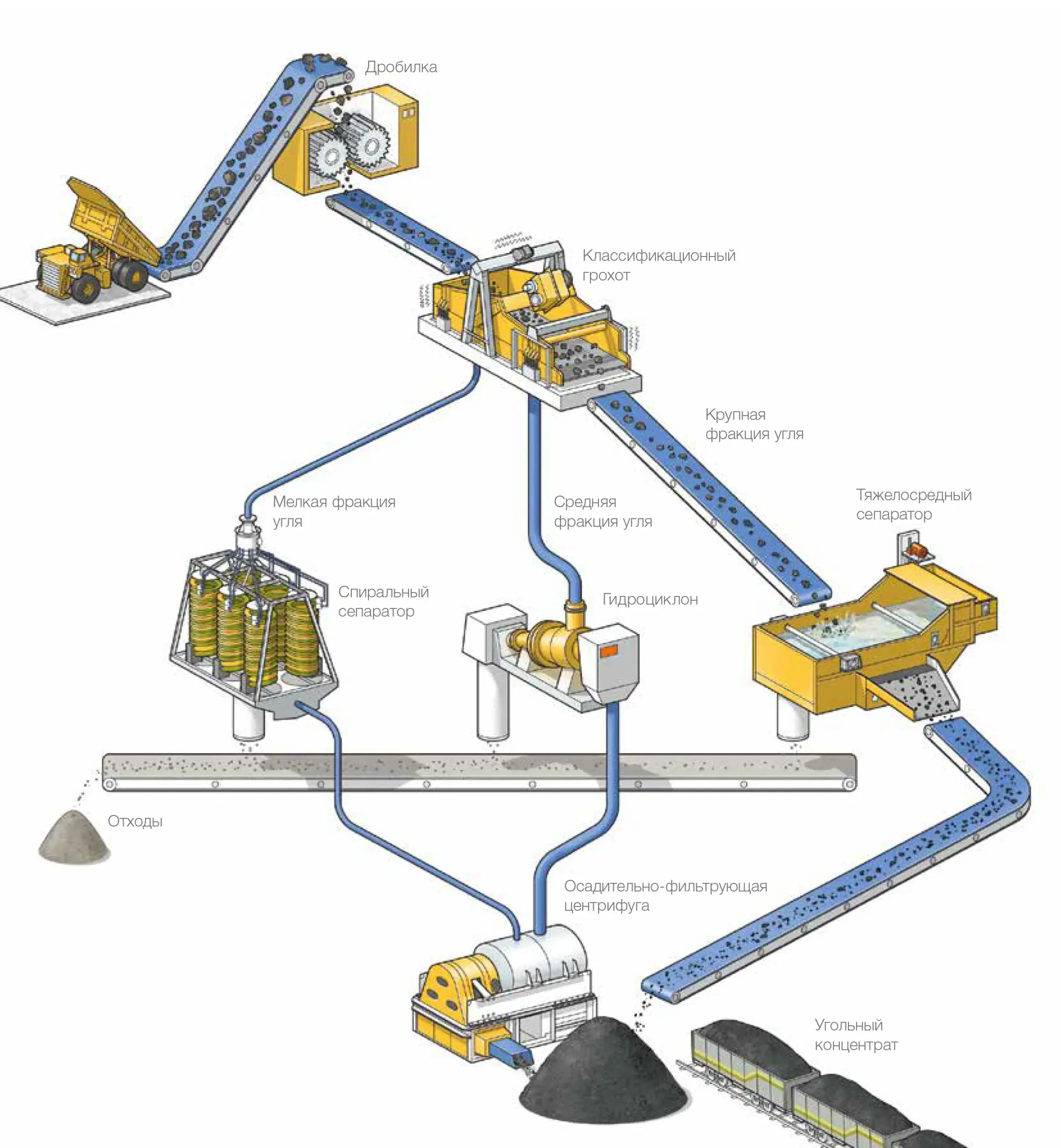
Mined rock is not yet a commodity. What comes out of a mine or open pit is called raw coal, since rock, ash, and sulfur come along with the mineral. Such raw materials provide less heat, wear out boilers faster and sell less well, so most of the mined coal is first goes for enrichment – to separate it from impurities and improve quality.
Gravity method
The most common and cheap way. It is based on the difference in density: coal is lighter than rock, so they separate in an aquatic environment. The method works well with large fractions from 0.5 mm. The output is a concentrate with low ash content, waste and middlings.
The fast and inexpensive technology of coal processing does not provide deep purification, because the gravitational method cannot cope with particles smaller than 0.5 mm.
Flotation
When it is necessary to enrich fine coal – fractions less than 0.15–0.2 mm – flotation is used. Reagents are added to the aqueous suspension, and air bubbles are passed through it. Coal particles stick to the bubbles and float in the foam, while the rock settles to the bottom.
Flotation is the only industrial method for fine grinding. It makes it possible to obtain coal with an ash content of up to 0.5–3%, which is used in chemical processing.
Deep processing: coal as a raw material, not a fuel
Getting rich is not the end point. Modern mining technologies make it possible to obtain fundamentally different products from coal: with pyrolysis – semi-coke and tars, with gasification – synthesis gas for the chemical industry, with liquefaction – synthetic liquid fuel. This direction of processing is directly regulated in Energy Strategy of the Russian Federation until 2050. The document recommends producing products with high added value instead of exporting raw coal.
So far, deep processing is poorly developed in Russia, but it is precisely this that can change the economy of the industry against the backdrop of falling export prices.
The entire energy transition is based on metals, and there is a catastrophic shortage of them. How the shortage of raw materials is related to the green agenda – we analyze in the article Net Zero and metal shortage: what the green transition hides
The future of coal mining technology
The industry is changing faster than it seems from the outside. For example, Kuzbassrazrezugol in 2024 received 3.6 billion rubles of economic effect from digital projects: Virtual twins help plan blasting operations and calculate production more accurately. At the open-pit mines “SDS-Ugol” and “Kuzbassrazrezugol” there are already tested unmanned BelAZ trucks. After such news, experts expect that by 2030 every tenth to fifteenth mining dump truck in Russia will drive without a driver.
Coal is not leaving the country’s energy balance. The Energy Strategy of the Russian Federation until 2050, approved in April 2025, envisages an increase in raw material consumption by 28% and the construction of new coal-fired power plants. So, understanding exactly how coal is mined—what method is chosen for a specific deposit and where in the chain the cost is formed—is useful for both a mining engineer and someone who makes investment decisions in the industry.
The cover photo was taken from the official website of the company JSC Management Company KUZBASSRAZREZUGOL