Do you want to know how much a geophysicist earns? Are you just choosing a profession and don’t know where to go? Or are you already working in a mine and wondering if the oil industry pays more? Maybe you’ve been conducting field work for the fifth year now, and you don’t understand whether you’ve remained at the bottom of the market or reached your maximum.
Salaries of geophysicists range from 60 to 350 thousand rubles. Where does this spread come from? Where do they pay more, and where is it more stable? Let’s figure out who gets paid, where, for what and how much – with examples of vacancies and tips on how to increase income.
Who is a geophysicist
A geophysicist is a specialist who uses physical methods to explore the interior of the Earth. It works with physical fields – gravitational, magnetic, electric, radioactive, as well as elastic (seismic) waves propagating through the Earth. These fields behave differently depending on the composition and structure of the rocks, the presence of voids, water or ore. By analyzing changes in the fields, the geophysicist gets an idea of what is at depth.
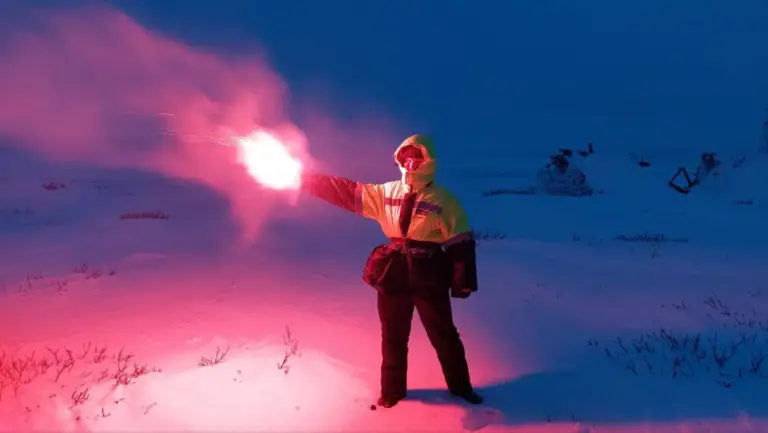
How geophysicists work in reality. Read the article “One of my days on the other side of the Arctic” – about the shift, conditions, routine and choice.
Geophysical methods make it possible to obtain this information without drilling or opening rocks, which makes them especially valuable in a variety of fields:
- search for minerals – from gold to copper and lithium;
- oil and gas exploration and well operation;
- hydrogeology, when searching for groundwater;
- engineering surveys – before the construction of bridges, tunnels, buildings;
- prediction of natural risks: karst, landslides, landslides and ground movements,
- in science – in the study of earthquakes and the internal structure of the Earth;
- in space research – when studying the fields of the Earth and other planets from space;
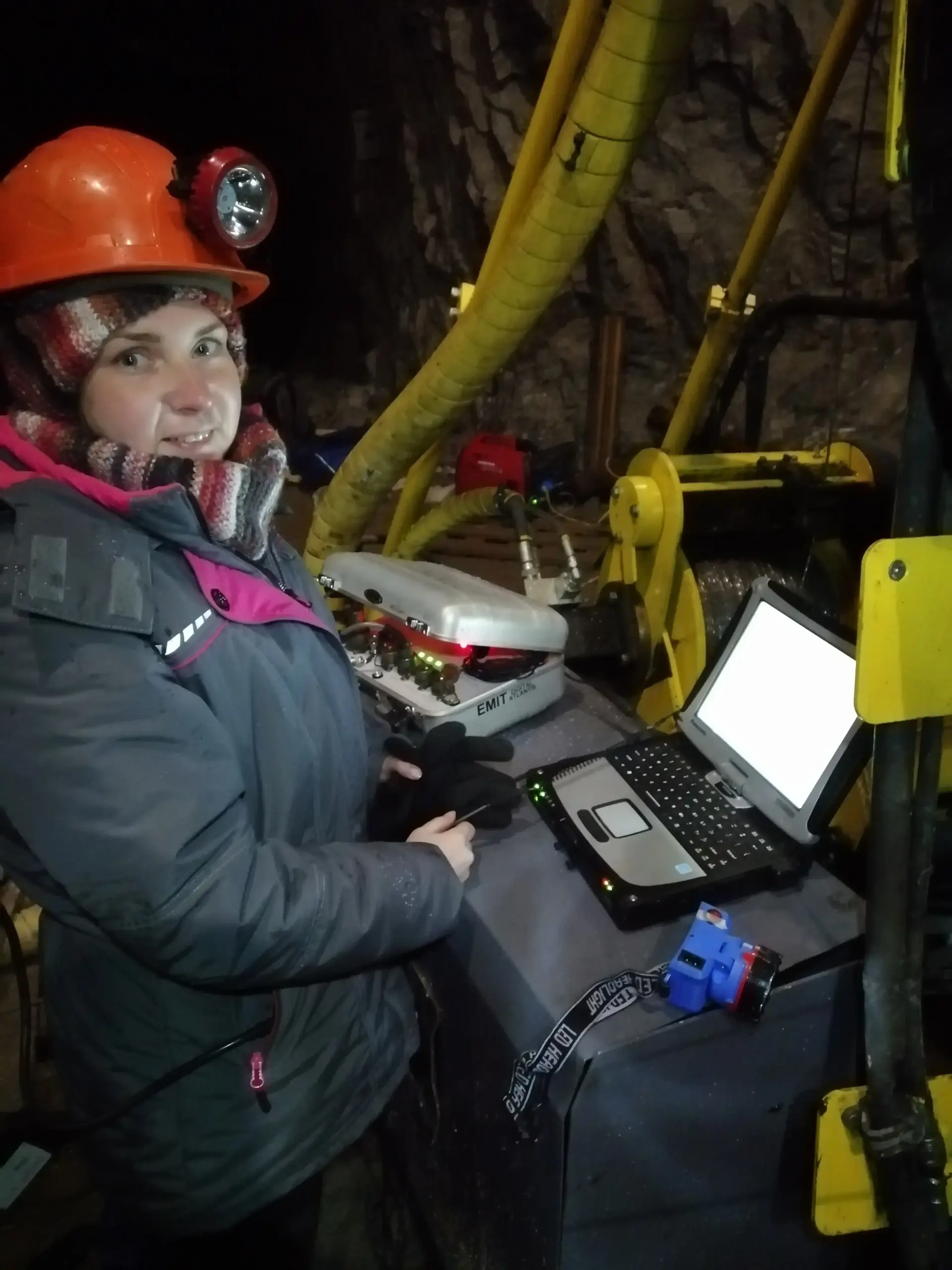
Geophysicists can work in a variety of conditions – on the surface, underground, in mines, on an oil platform, in the air and even in spacewhen the fields of other planets and satellites are explored.
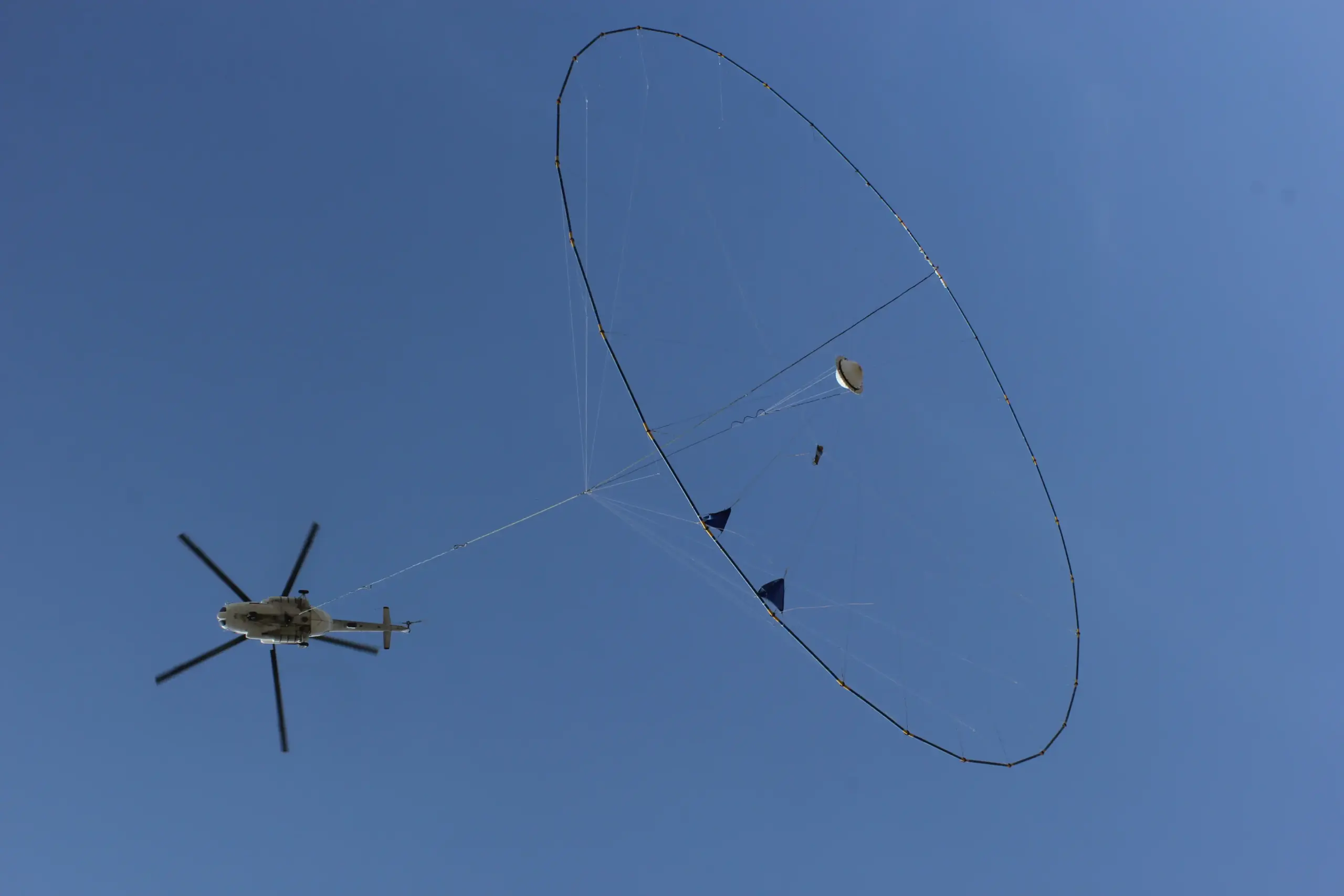
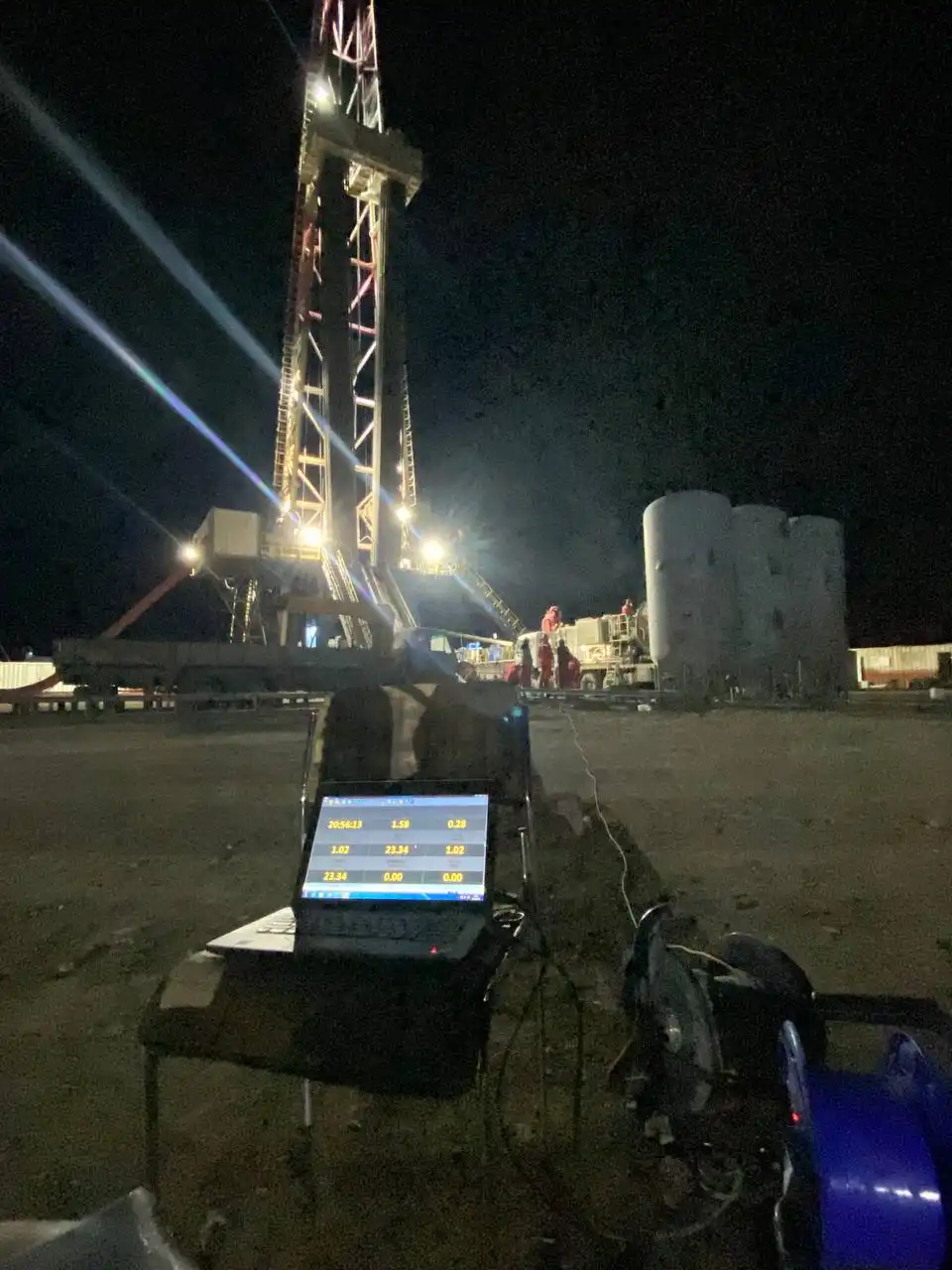
What does a geophysicist’s salary depend on?
A geophysicist’s salary can vary greatly depending on where exactly he works and what he does. One specialist can earn 70 thousand, another – many times more. Let’s consider the options:
From region: in the North, for example, there are regional allowances, so income there is usually higher.
From the area of employment: In science, salaries are usually lower, especially for young specialists. In engineering surveys and hydrogeology, the income level is average. But in geological exploration of solid minerals, and especially in the oil and gas industry, the pay level is higher.
From the work format: Shift work often pays better than office work.
From work experience: the more years in the profession, the higher the trust and level of responsibility. You can become a party leader, a project manager, or a data processing and interpretation department manager.
From specialization: Seismic exploration specialists – especially in oil and gas – traditionally earn more than electrical prospectors in engineering geophysics.
From the company: Private organizations typically pay more for similar positions than government ones.
From software ownership: for example, RadExPro, Oasis Montaj, Petrel, Kingdom, GeoGraphix, etc. The ability to work in such systems increases the value of a specialist in the market. There is an increasing demand for specialists who can work with machine learning algorithms to interpret data.
Read how geophysicists use AI in the article “How to search for deposits using artificial intelligence” – real cases of data interpretation and automation.
From the ability to present themselves: those specialists who can prove their worth to the employer, all other things being equal, can be paid more.
How much do geophysicists get paid?
To understand the order of the numbers, here are guidelines for the salaries of geophysicists in Russia and abroad:
| Grade | Salary, ₽ | Comment |
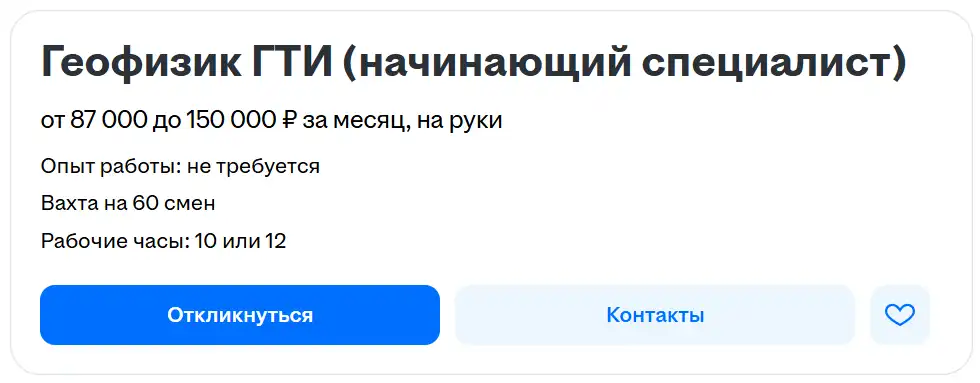
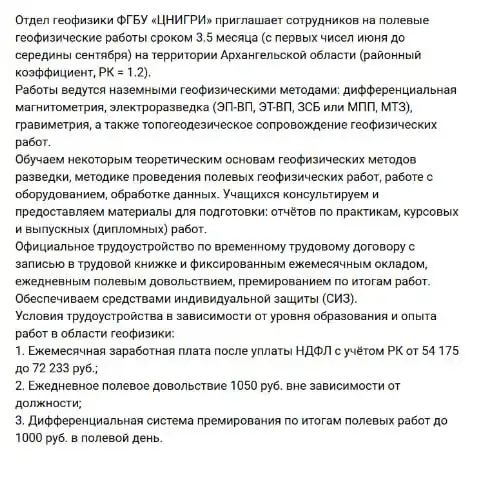
| Young specialist | 60 000–90 000 | central regions or shift |
| Engineer | 90 000–150 000 | office or project |
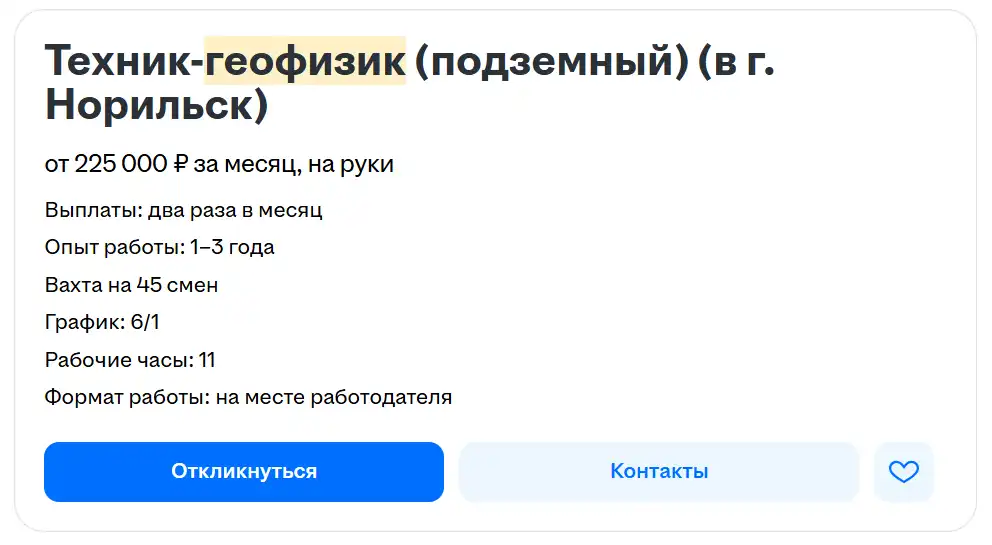
| Presenter/Chief | 150 000–300 000 | watch, North |
| Abroad | from 300,000 | only with experience and knowledge of English |
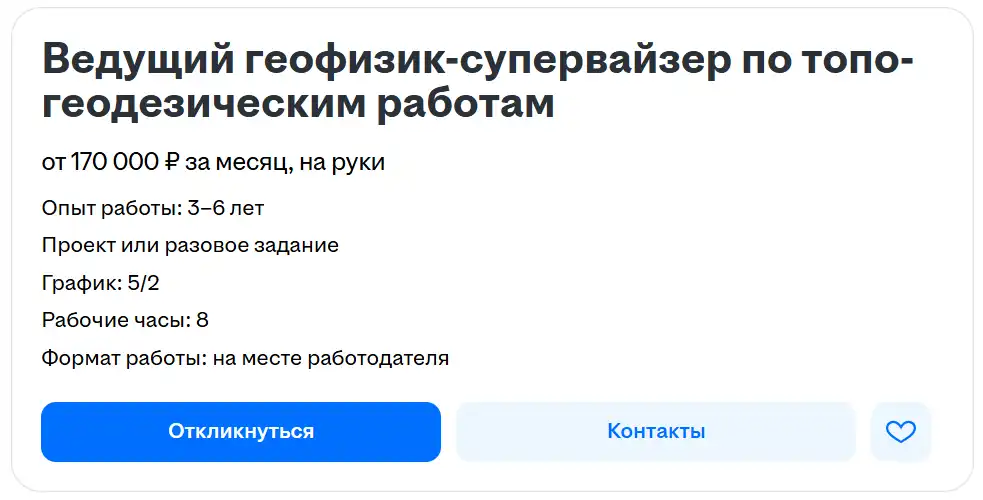
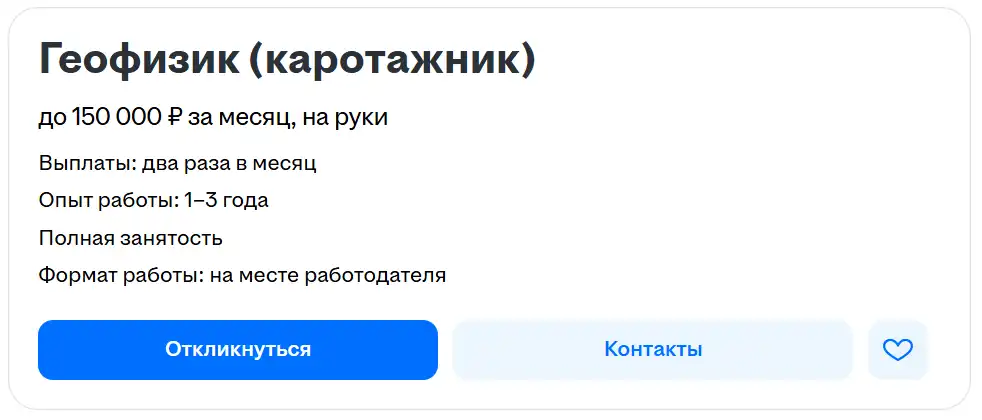
These numbers are average guidelines. In reality, a lot depends on the region, work format and experience.Now let’s look at the real vacancies from the Russian labor market: what conditions are offered and what employers require.

How to earn more
The easiest way for a young geophysicist to start earning money is to go to the fields. Shift work is difficult, but well paid. You live in a trailer or tent and eat in a field canteen. You can save more in a month than in three in the city. This is not for everyone, but it is one of the most effective ways to get started.
Over time, you can move on. Someone remains in the fields and becomes a team leader or project geophysicist. Some go to the office and interpret data, process or coordinate projects.
At any stage, it is important to be able to work with specialized programs. RadExPro, Petrel, Oasis Montaj are the basic tools. Knowledge of specialized software greatly increases the cost of a specialist. Now they are increasingly entering geophysics machine learning algorithms, and if you can work with AI, this is a competitive advantage.
But technical skills alone are becoming insufficient. To move to the next level, soft skills are important. The ability to introduce yourself, competently put together a resume, and talk about your achievements at an interview. Ability to negotiate, take responsibility, lead the team. If you want to grow towards leadership, you can’t do without it.
And finally English language. It opens doors to international companies, projects abroad and vacancies with a different salary level. This is not a “plus”, it is a condition if you want to go beyond the domestic market.
Overseas salaries are higher – I am currently paid 350 Canadian dollars a day. But I had to learn the language, understand the local rules and mentality. If you start preparing in advance – learn the language, participate in international projects – then it will be easier.
Maria Kostina
Are you already working in the profession or are you just choosing a direction? Share your experience and questions in the comments – let’s discuss it together.