International team geologists introduced a new way to determine the age of ancient rocks – they learned to accurately determine the age of fossilized dinosaur egg shells. The method is already being called a breakthrough: it helps to obtain accurate data where conventional methods do not work. The research, led by Dr Ryan Tucker from the Department of Geosciences at the University of Stellenbosch, was published in the journal Communications Earth & Environment.
Until now, researchers have often encountered situations where the age of fossils was only estimated. Minerals that are usually used for dating are not always found, and the bones or teeth of dinosaurs themselves rarely give clear results.
The researchers used an alternative approach, advanced uranium-lead (U-Pb) dating and elemental mapping, to find traces of uranium and lead in shell calcite. These elements work like a natural clock and show when the egg is in the rock.
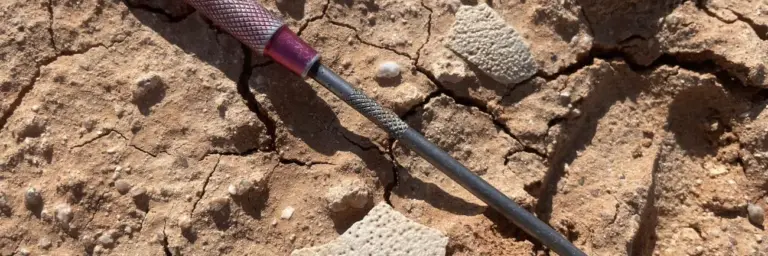
Scientists tested the method on materials from the USA and Mongolia. It turned out that the shell records time with high accuracy – the data differs from dating based on volcanic ash by only a few percent. In one of the Mongolian deposits For the first time, it was possible to determine the age of ancient masonry directly – about 75 million years.
The developers of the method note that it is especially useful in areas where there are no volcanic layers. It is now possible to reliably date areas that previously gave too wide time intervals. This takes the guesswork out of paleontologists and helps them more accurately compare the ages of species and ancient ecosystems.
The method has confirmed its effectiveness at various sites and is already attracting interest from research centers around the world. It is expected to become a new tool in the study of evolution and change the approach to dating important finds.
The material was prepared with the support of the Russian Ministry of Education and Science as part of the Decade of Science and Technology.
Source: https://www.su.ac.za
Photo: Lindsey Zanno